
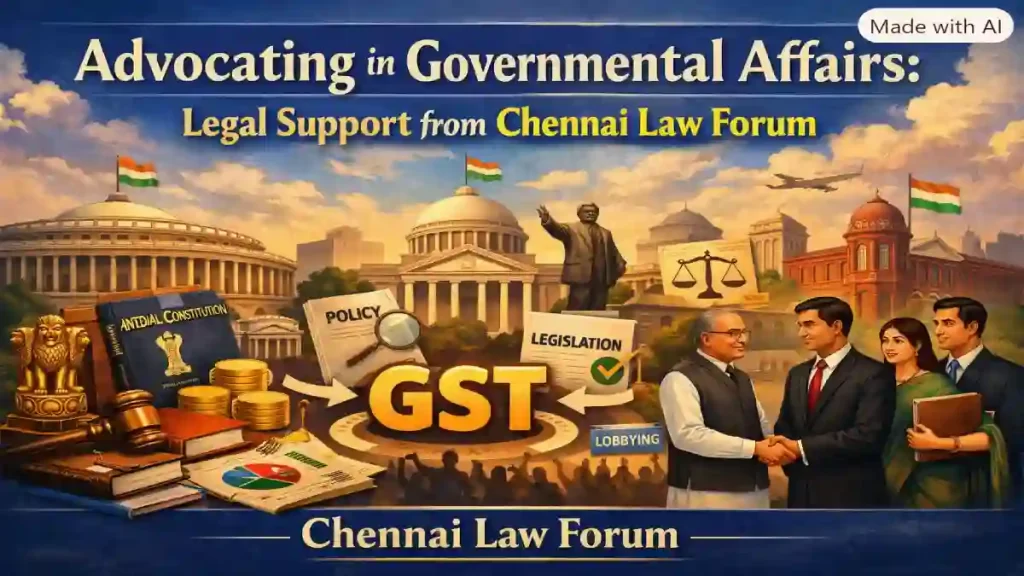
Advocating in Governmental Affairs – Governmental legal matters arise when individuals, companies, NGOs, or NRIs interact with public authorities. Common issues include licences, permissions, tenders, taxation, land approvals, environmental clearances, procurement, and regulatory decisions. Therefore, administrative law requires careful review of statutory powers and procedural fairness. Lawyers can examine whether an authority exceeded jurisdiction or ignored relevant evidence. Moreover, affected parties may challenge arbitrary, unreasonable, discriminatory, or procedurally defective decisions. The Constitution also supports judicial review of unlawful administrative action.
Depending on circumstances, remedies may include representation, statutory appeal, revision, writ proceedings, or injunctions. Additionally, the Right to Information Act, 2005 can assist eligible information requests. It promotes transparency and accountability within public authorities. Chennai Law Forum can evaluate the decision, identify the proper authority, and recommend an appropriate legal remedy. Early advice often prevents unnecessary escalation and preserves statutory limitation periods.
Advocating in Governmental Affairs: Legal Support from Chennai Law Forum – Senior Lawyers Chamber
Government Licences, Permissions and Approvals
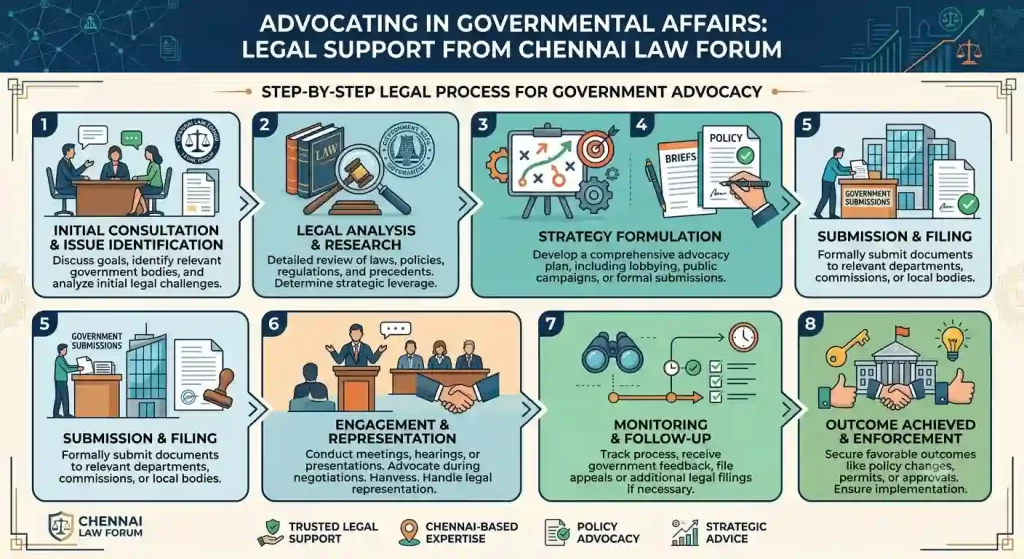
Government approvals influence businesses, infrastructure projects, charitable activities, and individual rights across Chennai. Examples include building permissions, trade licences, environmental approvals, registrations, renewals, and departmental clearances. However, delays can disrupt projects and create substantial financial consequences. A lawyer can identify the responsible department and examine applicable statutory timelines. Furthermore, written representations create an important administrative record for future proceedings. If an authority refuses an application, counsel can examine the reasons and supporting documents. Where appropriate, an appeal or judicial review may become available.
Additionally, RTI applications can help obtain records concerning administrative decisions. The RTI Act recognises citizens’ access to information held by public authorities, subject to statutory exemptions. Therefore, legal strategy should combine administrative engagement with evidence preservation. Chennai Law Forum can assist applicants, companies, NGOs, and NRIs with representations, appeals, and judicial remedies. Prompt action can reduce regulatory uncertainty and protect legitimate interests.
Public Procurement and Government Tender Disputes
Government tenders involve strict eligibility conditions, technical requirements, financial criteria, and procedural safeguards. Consequently, tender disputes require rapid legal assessment because procurement timelines can remain short. Common disputes involve disqualification, bid evaluation, technical rejection, blacklisting, earnest-money issues, and alleged procedural irregularities. A lawyer should first examine tender conditions and the applicable procurement framework. Furthermore, courts generally examine public procurement decisions carefully while respecting administrative expertise. Therefore, a challenge should identify demonstrable illegality, arbitrariness, discrimination, mala fides, or procedural unfairness.
Companies should preserve tender submissions, clarification letters, evaluation communications, and departmental correspondence. NGOs and contractors may similarly require representation concerning government-funded projects. Moreover, contractual disputes can involve arbitration clauses or specialised forums. Chennai Law Forum can assess whether representation, statutory review, arbitration, or writ proceedings offers the strongest remedy. Early legal intervention can protect bidding opportunities and reduce avoidable commercial losses.
Information, Grievances and Regulatory Representation
Right to Information and Government Records
Strategic Use of RTI Applications
The Right to Information Act, 2005 provides citizens with statutory access to information held by public authorities. Therefore, RTI can support government-affairs litigation by establishing factual records. Applicants may seek existing documents, orders, correspondence, policies, reports, and records. However, RTI does not require authorities to create information or provide answers outside available records. Lawyers can formulate precise requests that identify specific documents and periods. Furthermore, exemptions under the Act require careful consideration before challenging a refusal.
An applicant can pursue statutory appeal mechanisms when authorities reject or inadequately answer requests. Chennai Law Forum can assist with RTI strategy, first appeals, and information-related legal proceedings. Additionally, obtained records can support administrative representations or judicial review. Properly framed RTI requests often produce more useful evidence than broad questions. Consequently, legal guidance can improve both information gathering and subsequent litigation strategy.
Government Grievances and Departmental Representations
Government grievances often require communication with several administrative levels. A well-prepared representation should identify the authority, facts, legal basis, documents, and specific relief requested. Therefore, vague complaints may produce limited administrative responses. Lawyers can prepare representations concerning delays, unlawful demands, licensing problems, land matters, public services, or departmental decisions. Furthermore, escalation should follow the applicable grievance mechanism wherever available. A written record helps demonstrate that the affected party first sought administrative resolution.
If the authority fails to act, judicial remedies may become relevant depending on the circumstances. Chennai Law Forum can also identify whether a statutory appeal or specialised tribunal provides a better route. Additionally, public authorities must exercise statutory powers within legal boundaries. The Administrative Tribunals Act governs specified service disputes involving public employment and administrative tribunals. Consequently, forum selection remains essential before filing any proceeding.
Regulatory Compliance and Government Investigations
Regulatory investigations can affect companies, NGOs, institutions, and individuals across multiple sectors. Notices may originate from tax departments, municipal authorities, environmental agencies, labour authorities, financial regulators, or other government bodies. Therefore, recipients should not ignore statutory notices or informal departmental communications. Lawyers can examine jurisdiction, allegations, evidence, deadlines, and available responses. Furthermore, companies should preserve relevant records without altering or deleting material. A carefully drafted response can address factual errors while protecting legal rights. Where inspections occur, counsel can advise on cooperation and procedural safeguards.
Additionally, regulatory disputes may progress through departmental appeals, tribunals, or constitutional courts. The appropriate forum depends upon the governing legislation and challenged decision. Chennai Law Forum can coordinate responses across departments and proceedings. Consequently, businesses should seek advice before making admissions that could affect later litigation. A structured compliance strategy can reduce penalties, operational disruption, and prolonged regulatory uncertainty.
Government Litigation and Judicial Review
Judicial review provides an important remedy against unlawful administrative action. However, courts generally examine legality rather than replacing administrative decision-making with their own preferences. Therefore, pleadings should identify jurisdictional errors, procedural violations, irrationality, discrimination, or other recognised grounds. Depending upon the matter, proceedings may reach the Madras High Court or an appropriate statutory forum. Lawyers must also consider alternative remedies created by legislation. Furthermore, limitation and delay can significantly affect discretionary constitutional relief.
A complete case file should contain the challenged order, representations, acknowledgements, evidence, and relevant statutory provisions. Chennai Law Forum can prepare writ petitions, replies, affidavits, and supporting submissions where appropriate. Additionally, interim relief may become necessary when immediate harm threatens property, business operations, licences, or contractual rights. Courts may impose conditions while granting interim protection. Consequently, early legal assessment remains valuable when government action creates urgent consequences.
Forums, Remedies and Professional Government Affairs Support
Choosing Forums and Legal Remedies
Administrative Tribunals and Specialised Forums
Central Administrative Tribunal Matters
The Central Administrative Tribunal handles specified disputes involving recruitment and service conditions of covered public servants. The Administrative Tribunals Act, 1985 establishes its statutory framework and jurisdiction. Therefore, government employees should identify whether their dispute falls within tribunal jurisdiction. Typical matters can involve appointments, promotions, seniority, disciplinary action, transfers, and service benefits. However, procedural requirements and statutory remedies require careful examination. Lawyers can review departmental orders and available representations before filing proceedings.
Furthermore, limitation requirements can affect maintainability. Chennai Law Forum can advise eligible employees concerning pleadings, evidence, interim relief, and appellate strategy. Where another forum has jurisdiction, counsel can redirect the matter accordingly. Additionally, constitutional questions may require consideration of High Court remedies. Proper forum selection prevents wasted time and procedural objections. Consequently, employees should obtain legal advice before filing parallel proceedings before different authorities or courts.
Government Property and Land Disputes
Government land disputes can involve acquisition, encroachment allegations, patta issues, classifications, permissions, leases, and development restrictions. Therefore, legal review should begin with title documents and revenue records. Lawyers may need to examine proceedings issued by revenue authorities, municipal bodies, development agencies, or other departments. Furthermore, acquisition disputes can involve specialised statutory procedures and compensation mechanisms. Affected owners should preserve notices, survey records, orders, tax receipts, and correspondence. Where administrative remedies exist, counsel should assess their usefulness before approaching court.
Additionally, urgent injunction or interim protection may become necessary when possession or construction faces immediate interference. The appropriate remedy depends upon statutory jurisdiction and factual circumstances. Chennai Law Forum can coordinate revenue representations, statutory appeals, civil proceedings, or writ remedies. Consequently, early intervention may prevent irreversible changes to disputed property. Clear documentation also helps establish possession, title, procedural history, and the precise government action challenged.
Police Complaints and Public Authority Misconduct
Some government-affairs disputes may involve allegations of fraud, intimidation, forgery, corruption, or other criminal conduct. Such allegations require careful separation from ordinary administrative disagreements. The Bharatiya Nyaya Sanhita, Bharatiya Nagarik Suraksha Sanhita, and Bharatiya Sakshya Adhiniyam now form India’s principal criminal-law framework. Therefore, lawyers should identify the correct offence, procedure, evidence, and competent authority. Tamil Nadu Police provides citizen services, online complaint facilities, and information concerning Chennai police stations.
Where appropriate, a complaint may be submitted to the relevant police station or senior police authority. However, police action cannot replace statutory administrative remedies in every dispute. Chennai Law Forum can evaluate whether criminal, civil, administrative, or constitutional proceedings should proceed separately. Additionally, evidence should remain preserved in its original form. Prompt legal advice can protect complainants while reducing the risk of unsupported allegations.
Remedies Against Unlawful Government Decisions
Government-affairs remedies depend upon the statute, authority, affected right, and procedural history. Common remedies include representation, reconsideration, statutory appeal, revision, review, injunction, writ petition, compensation, and tribunal proceedings. Therefore, lawyers should identify the remedy capable of producing the requested outcome. A representation may resolve a simple administrative error without litigation. Conversely, an unlawful final order may require appellate or judicial intervention. Furthermore, interim relief can protect rights while proceedings remain pending.
Courts may also issue directions requiring authorities to reconsider matters according to law. Chennai Law Forum can assess whether mandamus, certiorari, prohibition, or other constitutional remedies apply. However, constitutional remedies remain discretionary and depend upon established legal principles. Additionally, statutory appeal requirements may affect writ maintainability. Consequently, forum and remedy selection should occur before drafting proceedings. A focused legal strategy saves costs and improves the prospects of obtaining effective relief.
Government Affairs Legal Representation
Corporate and NGO Government Relations
Corporate Regulatory Representation
Companies regularly interact with government departments concerning licences, inspections, taxation, labour compliance, environmental requirements, procurement, and sectoral regulation. Therefore, regulatory decisions can directly affect commercial operations. Lawyers can review notices, prepare responses, attend hearings, and advise management on statutory obligations. Furthermore, companies may require assistance during inspections, investigations, audits, and enforcement proceedings. A legal team can coordinate information requests and preserve privilege where applicable. Additionally, contractual arrangements with government bodies may require tender, procurement, or arbitration analysis.
Chennai Law Forum can provide representation before departments, regulators, tribunals, and courts. Consequently, businesses can address government interactions through structured legal channels rather than informal negotiations. Early compliance reviews can identify risks before authorities issue adverse notices. Where litigation becomes necessary, counsel can prepare pleadings supported by statutory provisions and documentary evidence. This approach promotes regulatory certainty and protects legitimate commercial interests.
NGO and Charitable Organisation Assistance
NGOs and charitable organisations often require government registrations, permissions, grants, compliance filings, and regulatory approvals. Therefore, administrative delays or adverse decisions can disrupt charitable activities. Lawyers can review registration records, departmental communications, funding conditions, and statutory requirements. Furthermore, organisations may need representation before charity authorities, government departments, tax authorities, or courts. RTI mechanisms can sometimes assist with obtaining public records relevant to administrative decisions. Chennai Law Forum can prepare representations, replies, appeals, and judicial proceedings where legally appropriate.
Additionally, organisations should maintain governance documents and regulatory correspondence systematically. Compliance failures can create avoidable notices, penalties, or suspension risks. Consequently, periodic legal review can strengthen institutional governance. Where a government decision affects charitable operations, counsel can assess proportionality, statutory authority, and available remedies. Professional assistance allows NGOs to pursue lawful objectives while maintaining transparent government relationships and regulatory compliance.
NRI and Cross-Border Government Matters
NRIs frequently require legal assistance with property, inheritance, taxation, investment, registrations, government records, and administrative approvals in India. Therefore, distance can make departmental communication particularly difficult. Lawyers can act through appropriate authorisations where representation is legally permitted. Furthermore, NRIs may need assistance obtaining certified records, responding to notices, or pursuing property-related administrative remedies. Power of attorney documents should receive careful review before use.
Additionally, cross-border matters may involve foreign documentation, notarisation, apostille, or consular requirements. Chennai Law Forum can coordinate local representation and communicate with relevant government authorities. Where disputes reach courts or tribunals, counsel can manage procedural requirements and hearing representation. Consequently, NRIs should avoid relying solely on informal agents for sensitive government matters. Proper legal oversight reduces risks involving property, records, compliance, and authority. Early consultation can also identify jurisdictional issues before deadlines expire.
Professional Legal Support from Chennai Law Forum
Chennai Law Forum provides legal support for individuals, companies, NGOs, and NRIs dealing with government authorities. Services can include administrative law advice, departmental representation, RTI strategy, regulatory compliance, tender disputes, tribunal matters, writ petitions, and government litigation. Therefore, every engagement should begin with identifying the authority and legal issue. Lawyers can then review documents, applicable legislation, jurisdiction, limitation, and available remedies. Furthermore, counsel can communicate with departments and represent clients during hearings where permitted. Statutory forums and tribunals require specialised procedural knowledge.
Courts also require precise pleadings supported by evidence and relevant law. Additionally, criminal allegations involving public officials require separate analysis under BNS, BNSS, and BSA. Chennai police maintain citizen services and station information for appropriate complaints. Consequently, integrated legal support helps clients select proportionate and legally sustainable remedies. The objective remains lawful government engagement, effective dispute resolution, and protection of clients’ rights.
Frequently Asked Questions
1. What does governmental affairs legal support involve?
It covers government notices, licences, approvals, tenders, RTI, regulatory disputes, administrative appeals, tribunals, writ petitions, and representation before public authorities.
2. Can Chennai Law Forum challenge an arbitrary government decision?
Yes. Lawyers can examine jurisdiction, statutory compliance, procedural fairness, and constitutional grounds before recommending representation, appeal, tribunal proceedings, or judicial review.
3. Can companies obtain legal help for government tender disputes?
Yes. Counsel can review tender conditions, disqualification, evaluation, blacklisting, procurement procedures, and available remedies before the competent authority, tribunal, or court.
4. Can NGOs obtain assistance with government departments?
Yes. NGOs can receive assistance concerning registrations, permissions, grants, compliance, departmental notices, RTI, appeals, and appropriate judicial remedies.
5. Can NRIs receive representation for Indian government matters?
Yes. Subject to applicable procedures, NRIs can obtain local legal representation for property, records, administrative notices, approvals, taxation, and court or tribunal proceedings.
6. When should I consult a government affairs lawyer?
Consult promptly after receiving a notice, adverse order, licence refusal, tender rejection, investigation request, or regulatory communication. Early advice helps preserve evidence and limitation rights.
Read More
- Legal Services for Government Contractors: Chennai Law Forum Expertise
- Drafting Gift Deeds: Expert Legal Assistance in Chennai
- Fighting Fraud Cases: Legal Advocacy from Chennai Law Forum
- Legal Support for Franchise Agreements: Chennai Law Forum Guidance
- Addressing Foreign Technology Transfer Agreements: Chennai Law Forum Expertise
- India Code · Right to Information Act, 2005