
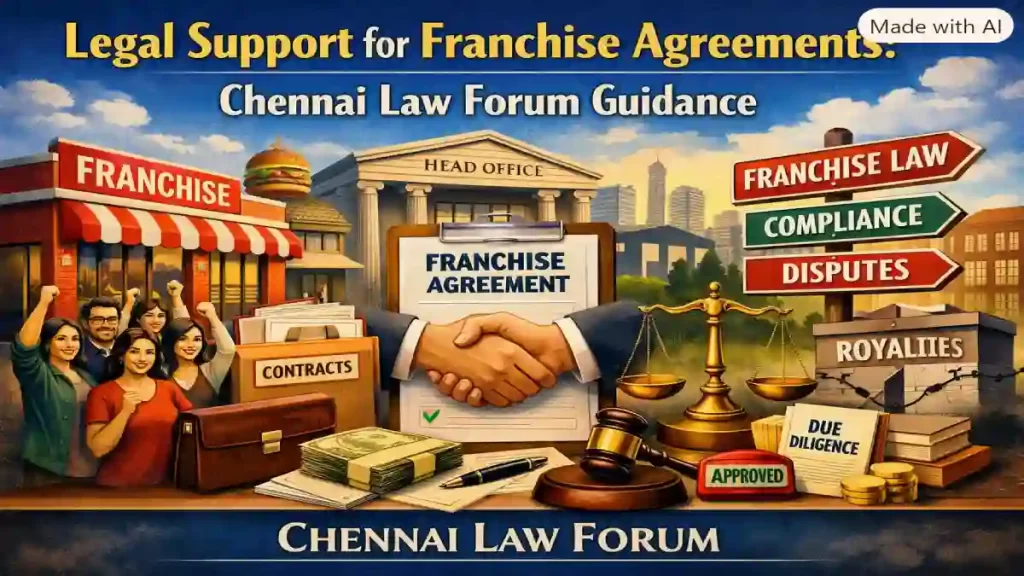
Legal Support for Franchise Agreements – Franchise agreements create valuable business opportunities while establishing clear legal rights and commercial responsibilities. Every franchisor and franchisee should understand contractual obligations before signing any agreement. Therefore, professional legal guidance reduces commercial risks and future disputes. Chennai Law Forum advises businesses, startups, investors, and entrepreneurs on franchise documentation and regulatory compliance. Franchise disputes commonly involve intellectual property, territorial rights, royalty payments, confidentiality, licensing, termination, and breach of contractual obligations.
Moreover, carefully drafted agreements protect both commercial interests and long-term business relationships. Indian contract laws, intellectual property laws, competition principles, and commercial regulations influence franchise transactions. Courts expect contractual clarity and fair commercial conduct. Consequently, experienced legal assistance strengthens negotiations, prevents disputes, and supports sustainable business growth across Chennai and throughout India.
Legal Support for Franchise Agreements: Chennai Law Forum Guidance – Chennai Law Forum: Senior Lawyers Chamber
Understanding Franchise Agreements Under Indian Commercial Laws
A franchise agreement governs the legal relationship between a franchisor and franchisee. Every clause defines commercial rights, operational responsibilities, financial obligations, and dispute resolution mechanisms. Consequently, businesses should review every contractual provision before execution. Franchise arrangements frequently cover trademarks, trade secrets, operational manuals, quality standards, supply obligations, marketing rights, territorial exclusivity, and royalty structures. Indian law recognizes contractual freedom subject to statutory limitations and public policy. Moreover, businesses should ensure compliance with the Indian Contract Act, intellectual property legislation, taxation laws, and applicable regulatory requirements. Well-drafted agreements reduce uncertainty during commercial operations. Professional legal review also identifies ambiguous clauses before execution. Therefore, businesses protect investments while minimizing litigation risks before commercial courts, arbitral tribunals, and constitutional courts.
Essential Clauses in Every Franchise Agreement
A comprehensive franchise agreement protects commercial interests through carefully drafted contractual provisions. Businesses should negotiate important clauses before signing the final document. Additionally, legal review prevents hidden contractual risks. Franchise agreements generally specify intellectual property rights, operational standards, payment obligations, renewal conditions, termination rights, dispute resolution procedures, confidentiality obligations, and non-compete restrictions. Every commercial relationship requires contractual certainty. Consequently, parties reduce misunderstandings and preserve long-term cooperation. Lawyers also assess enforceability under applicable Indian laws. Courts generally interpret agreements according to contractual language and surrounding circumstances. Therefore, businesses should avoid vague or inconsistent contractual terms. Professional drafting improves legal certainty while strengthening commercial relationships between franchisors and franchisees.
Common Legal Issues in Franchise Agreements
Franchise relationships occasionally generate contractual disputes requiring timely legal intervention. Businesses should identify legal risks before executing agreements. Furthermore, preventive legal advice minimizes commercial uncertainty.
- Royalty payment disputes.
- Trademark infringement.
- Territorial exclusivity conflicts.
- Confidentiality breaches.
- Unfair termination.
- Misrepresentation during negotiations.
- Quality control disputes.
- Non-compete disagreements.
- Supply chain obligations.
- Intellectual property misuse.
Early legal review reduces litigation exposure significantly. Consequently, businesses preserve commercial relationships while protecting contractual rights. Proper compliance also strengthens negotiation opportunities whenever disputes arise.
Authorities and Forums Handling Franchise Disputes
Commercial disputes proceed before different authorities depending upon contractual terms and applicable laws. Correct forum selection improves procedural efficiency considerably. Therefore, legal evaluation remains essential.
| Authority / Forum | Primary Role |
|---|---|
| Commercial Courts | Commercial contract disputes |
| Civil Courts | Civil contractual remedies |
| Madras High Court | Appeals and writ jurisdiction |
| Supreme Court of India | Final appellate jurisdiction |
| Arbitration Tribunal | Contractual arbitration proceedings |
| Mediation Centres | Settlement facilitation |
Businesses should evaluate dispute resolution clauses carefully before initiating proceedings. Professional legal advice improves procedural strategy while reducing unnecessary litigation expenses.
Legal Framework Governing Franchise Agreements
Several Indian statutes regulate franchise transactions indirectly through contractual and intellectual property principles. Every agreement should comply with applicable legal requirements. Moreover, legal compliance strengthens enforceability.
Important laws include:
- Indian Contract Act, 1872.
- Trade Marks Act, 1999.
- Copyright Act, 1957.
- Code of Civil Procedure, 1908.
- BNS, 2023.
- Bharatiya Nagarik Suraksha Sanhita, 2023.
- Bharatiya Sakshya Adhiniyam, 2023.
Fraud, forgery, cheating, or criminal breach involving franchise transactions may require investigation through nearby police stations wherever cognizable offences exist. Criminal proceedings may continue independently according to applicable legal provisions.
Advantages of Professional Franchise Legal Support
Experienced legal advisors strengthen franchise transactions before disputes arise. Businesses benefit from proactive contractual planning and regulatory compliance. Therefore, professional assistance creates long-term commercial stability.
Key benefits include:
- Comprehensive agreement drafting.
- Contract review.
- Trademark protection.
- Risk assessment.
- Regulatory compliance.
- Negotiation support.
- Dispute resolution.
- Litigation representation.
Professional legal guidance reduces contractual uncertainty considerably. Consequently, franchisors and franchisees protect investments while improving business continuity before commercial courts, arbitral tribunals, and other competent legal forums.
Drafting and Negotiating Franchise Agreements for Long-Term Success
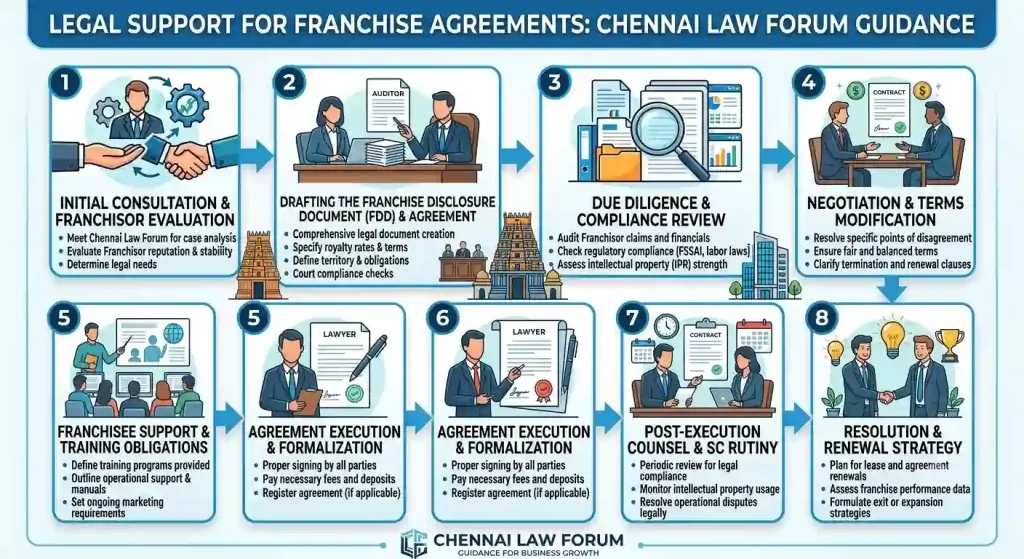
Successful franchise relationships begin with carefully negotiated agreements protecting both commercial objectives and legal rights. Every clause should reflect operational realities and future business expansion. Moreover, businesses should evaluate financial obligations before execution. Franchise lawyers examine royalty structures, licensing rights, renewal conditions, territorial restrictions, intellectual property ownership, confidentiality obligations, and dispute resolution mechanisms comprehensively. Clear drafting reduces ambiguity during business operations. Consequently, parties avoid unnecessary contractual conflicts and expensive litigation. Chennai Law Forum assists franchisors and franchisees throughout negotiations while identifying hidden legal risks. Businesses also benefit from due diligence before investing substantial capital. Therefore, professionally drafted franchise agreements create stronger commercial relationships, regulatory compliance, and sustainable business growth across competitive markets.
Regulatory Compliance and Business Risk Management
Franchise businesses operate within multiple legal and regulatory frameworks requiring continuous compliance. Companies should establish internal compliance systems immediately after executing agreements. Additionally, periodic legal audits identify emerging contractual risks. Businesses must comply with taxation laws, labour laws, intellectual property regulations, consumer protection requirements, competition principles, and local licensing obligations wherever applicable. Consequently, proactive compliance reduces enforcement actions and contractual disputes. Chennai Law Forum advises clients regarding commercial governance, legal documentation, statutory obligations, and contractual performance monitoring. Regular compliance reviews strengthen investor confidence while protecting valuable business assets. Furthermore, legal advisors recommend corrective measures whenever operational deficiencies appear. Effective compliance management ultimately minimizes commercial exposure and strengthens franchise stability throughout the contractual relationship.
Essential Documents Supporting Franchise Transactions
Strong documentation protects contractual rights and simplifies dispute resolution. Businesses should organize commercial records systematically throughout the franchise relationship. Moreover, documentary consistency strengthens legal credibility before courts and arbitral tribunals.
Important documents include:
- Franchise agreement.
- Trademark licence.
- Business registration records.
- GST registration documents.
- Payment receipts.
- Royalty statements.
- Confidentiality agreements.
- Operations manuals.
- Marketing approvals.
- Communication records.
Proper documentation reduces evidentiary disputes significantly. Consequently, businesses establish contractual compliance more effectively during negotiations, arbitration, litigation, and regulatory proceedings. Early document management also minimizes future legal uncertainty.
Legal Remedies for Franchise Agreement Disputes
Indian law provides several remedies for contractual breaches arising from franchise relationships. Businesses should evaluate every remedy according to factual circumstances. Furthermore, strategic legal advice improves enforcement outcomes.
| Legal Remedy | Purpose |
|---|---|
| Specific Performance | Enforce contractual obligations |
| Permanent Injunction | Prevent continuing breaches |
| Temporary Injunction | Preserve rights during litigation |
| Damages | Recover financial losses |
| Contract Rescission | Cancel defective agreements |
| Arbitration Award | Resolve contractual disputes |
| Mediation Settlement | Achieve negotiated resolution |
| Declaratory Relief | Clarify legal rights |
Legal professionals recommend appropriate remedies after reviewing contractual obligations and supporting evidence. Consequently, businesses protect commercial interests while minimizing operational disruption.
Government Departments and Regulatory Authorities
Several government authorities influence franchise operations through taxation, intellectual property, and corporate regulation. Businesses should maintain compliance with every applicable regulator. Additionally, regulatory guidance reduces commercial risk.
Relevant authorities include:
- Ministry of Corporate Affairs.
- Central Board of Indirect Taxes and Customs.
- Controller General of Patents, Designs and Trade Marks.
- Department for Promotion of Industry and Internal Trade.
- Registrar of Companies.
- Goods and Services Tax Authorities.
- Local Municipal Authorities.
- Labour Department where applicable.
Regulatory compliance strengthens contractual enforceability considerably. Consequently, businesses reduce legal exposure while maintaining responsible commercial governance across franchise networks.
Common Franchise Litigation Issues
Commercial disputes frequently arise from contractual interpretation and operational performance. Businesses should recognize recurring legal challenges before they escalate. Therefore, preventive legal advice remains essential.
Common legal issues include:
- Breach of franchise agreement.
- Trademark misuse.
- Royalty payment defaults.
- Territorial encroachment.
- Unauthorized disclosure of trade secrets.
- Non-renewal disputes.
- Wrongful termination.
- Consumer complaints.
- GST compliance issues.
- Misrepresentation during franchise sales.
Experienced legal representation resolves these issues efficiently. Consequently, franchisors and franchisees preserve business continuity while protecting valuable contractual and intellectual property rights.
Legal Services Offered by Chennai Law Forum
Professional legal support extends throughout the franchise lifecycle. Businesses require strategic advice before, during, and after executing agreements. Moreover, experienced lawyers provide practical commercial solutions.
Chennai Law Forum offers:
- Franchise agreement drafting.
- Contract review.
- Legal due diligence.
- Trademark advisory.
- Compliance audits.
- Negotiation support.
- Arbitration representation.
- Commercial Court litigation.
- High Court proceedings.
- Supreme Court appellate assistance.
Comprehensive legal services strengthen contractual certainty substantially. Therefore, businesses confidently establish, manage, expand, and protect franchise operations while reducing commercial and legal risks across India.
Handling Civil and Criminal Issues in Franchise Disputes
Franchise disputes sometimes extend beyond contractual disagreements into civil and criminal proceedings. Therefore, businesses should evaluate every legal consequence before taking action. Fraudulent inducement, forged agreements, trademark counterfeiting, criminal breach of trust, cheating, and document fabrication may require criminal investigation. Nearby police stations may register cognizable offences where statutory requirements exist. Additionally, investigating agencies may proceed under the Bharatiya Nyaya Sanhita, 2023, while investigation follows the Bharatiya Nagarik Suraksha Sanhita, 2023. Courts assess documentary, electronic, and oral evidence under the Bharatiya Sakshya Adhiniyam, 2023. Civil proceedings before Commercial Courts or arbitral tribunals may continue independently whenever legally permissible. Consequently, timely legal advice protects commercial interests, preserves evidence, and supports coordinated civil and criminal remedies against contractual misconduct.
Future Legal Trends in Franchise Business Agreements
Franchise law continues evolving through digital commerce, intellectual property protection, and expanding regulatory compliance. Businesses increasingly rely upon technology-driven agreements and electronic records. Moreover, courts recognize digital evidence more frequently during commercial litigation. Artificial intelligence, online franchise platforms, cybersecurity obligations, and data protection influence modern franchise operations. Consequently, businesses should update contractual terms regularly to address emerging commercial risks. Periodic legal audits improve compliance while reducing litigation exposure. Chennai Law Forum advises clients regarding changing judicial precedents, regulatory developments, and contractual best practices. Furthermore, effective governance promotes investor confidence and sustainable business expansion. Continuous legal review ultimately strengthens commercial relationships while protecting valuable intellectual property, contractual rights, and long-term profitability across competitive franchise markets.
Franchise Agreement Compliance Checklist
Businesses should complete a legal review before signing or renewing every franchise agreement. Careful preparation strengthens enforceability and minimizes disputes. Additionally, systematic verification improves commercial certainty.
| Compliance Item | Verify Before Execution |
|---|---|
| Franchise Agreement Reviewed | Yes |
| Trademark Rights Confirmed | Yes |
| Territory Defined | Yes |
| Royalty Structure Verified | Yes |
| Confidentiality Clauses Included | Yes |
| Dispute Resolution Clause Added | Yes |
| GST Compliance Reviewed | Yes |
| Regulatory Licences Verified | Yes |
| Legal Due Diligence Completed | Yes |
| Advocate Consultation Completed | Yes |
Completing this checklist significantly reduces contractual uncertainty. Therefore, businesses protect investments while strengthening legal compliance and operational efficiency.
Conclusion
A well-drafted franchise agreement creates strong commercial foundations and reduces avoidable legal disputes. Businesses should prioritize legal due diligence before investing in franchise opportunities. Moreover, continuous compliance supports sustainable business growth and protects valuable commercial assets. Chennai Law Forum provides comprehensive legal services covering agreement drafting, contract review, negotiation, intellectual property protection, dispute resolution, arbitration, Commercial Court litigation, and appellate proceedings. Professional legal guidance enables franchisors and franchisees to address contractual challenges confidently. Consequently, businesses minimize legal risks while strengthening profitability and operational stability. Strategic legal support ensures that every franchise relationship remains compliant, enforceable, and commercially successful under India’s evolving legal framework.
Frequently Asked Questions
1. Why is a franchise agreement legally important?
A franchise agreement defines commercial rights, operational duties, intellectual property usage, payment obligations, dispute resolution, and termination conditions, protecting both contracting parties.
2. What legal issues commonly arise in franchise agreements?
Common disputes involve royalty payments, trademark infringement, confidentiality breaches, territorial conflicts, wrongful termination, contractual breaches, and regulatory compliance issues.
3. Which courts handle franchise agreement disputes in Chennai?
Commercial Courts, Civil Courts, arbitral tribunals, the Madras High Court, and the Supreme Court may decide disputes depending upon jurisdiction and contractual provisions.
4. Can franchise disputes involve criminal proceedings?
Yes. Fraud, forgery, cheating, counterfeit trademarks, or criminal breach of trust may invite investigation under applicable criminal laws alongside civil proceedings.
5. What documents should parties preserve for franchise disputes?
Maintain franchise agreements, payment records, trademark licences, GST records, correspondence, operational manuals, invoices, notices, and all supporting commercial documents.
6. How can Chennai Law Forum help with franchise agreements?
Chennai Law Forum provides agreement drafting, contract review, legal due diligence, negotiation, compliance advice, arbitration, litigation, and appellate representation for franchise matters.
Read More
- Addressing Foreign Technology Transfer Agreements: Chennai Law Forum Expertise
- Legal Services for Foreign Investment: Expert Assistance from Chennai Law Forum
- Expert Assistance for Foreign Exchange Management Act (FEMA) Matters
- Seeking Legal Support for Foreign Collaboration: Chennai Law Forum Expertise
- Protecting Food Initiative Rights: Legal Assistance in Chennai
- Ministry of Corporate Affairs (MCA)