
Addressing Foreign Technology Transfer – Foreign Technology Transfer Agreements enable Indian businesses to access global innovation, manufacturing methods, proprietary software, patents, trademarks, and technical know-how. Therefore, these agreements demand careful legal drafting and regulatory compliance. Chennai Law Forum advises startups, manufacturers, software companies, research institutions, MSMEs, and multinational corporations on technology collaborations. Every agreement should clearly define ownership, licensing rights, confidentiality obligations, payment terms, and dispute resolution mechanisms. Businesses must also evaluate compliance with the Foreign Exchange Management Act, Intellectual Property laws, Competition Act, and applicable sectoral regulations.
Government approvals may become necessary depending upon the transaction structure. Proper due diligence minimizes future contractual disputes and regulatory penalties. Strategic legal planning protects intellectual assets while encouraging commercial growth. Our legal team represents clients before commercial courts, arbitration tribunals, High Courts, the Supreme Court, and other competent forums throughout India whenever technology transfer disputes arise.
Addressing Foreign Technology Transfer Agreements: Chennai Law Forum Expertise – Chennai Law Forum: Senior Lawyers Chamber
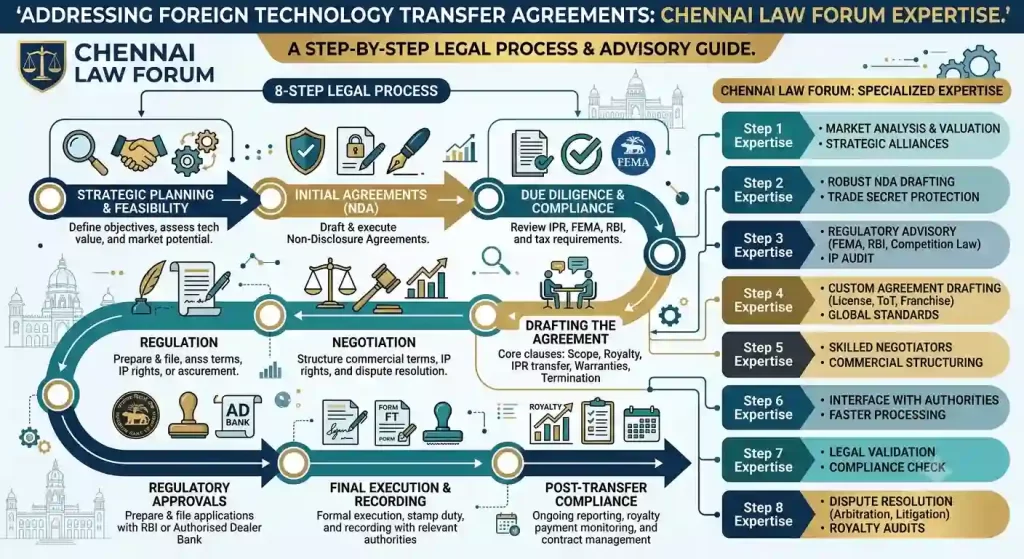
Legal Framework Governing Technology Transfer Agreements
Indian law recognizes technology transfer arrangements through several interconnected statutes and regulatory frameworks. Consequently, businesses should examine every legal requirement before executing cross-border agreements. The Indian Contract Act, 1872 governs contractual obligations between parties. Intellectual property legislation protects patents, copyrights, trademarks, industrial designs, and trade secrets. The Foreign Exchange Management Act regulates cross-border payments and royalty transactions. Competition law prevents anti-competitive licensing restrictions affecting market competition. Sector-specific regulations may impose additional compliance obligations. Companies should also review taxation, transfer pricing, customs duties, and import regulations.
Proper legal drafting minimizes ambiguity while strengthening enforceability. Professional legal advice ensures contractual clauses align with Indian statutory requirements. Chennai Law Forum regularly assists clients before regulatory authorities, commercial courts, arbitral tribunals, High Courts, and the Supreme Court regarding technology licensing, collaboration agreements, and intellectual property enforcement.
Types of Foreign Technology Transfer Agreements
Businesses adopt different technology transfer structures depending upon commercial objectives and industry requirements. Accordingly, legal documentation should reflect transaction-specific obligations and regulatory compliance. Common agreement categories include licensing, technical collaboration, franchise arrangements, research partnerships, software licensing, and manufacturing assistance. Each structure creates distinct legal rights and commercial responsibilities. Parties should define ownership, improvements, confidentiality, liability, termination, and dispute resolution carefully. Consider these common agreement types:
| Agreement Type | Primary Purpose | Typical Industry |
|---|---|---|
| Patent License | Technology utilization | Manufacturing |
| Technical Collaboration | Production assistance | Engineering |
| Software License | Software usage | Information Technology |
| Know-How Agreement | Technical expertise | Industrial Production |
| Research Collaboration | Joint innovation | Biotechnology |
Proper agreement selection reduces legal uncertainty while supporting long-term commercial success across international markets.
Essential Clauses Protecting Business Interests
Every foreign technology transfer agreement should contain carefully drafted contractual clauses protecting both commercial and intellectual property interests. Therefore, businesses should avoid using generic contractual templates. Strong agreements define licensed technology, permitted use, territorial restrictions, exclusivity, royalty mechanisms, confidentiality, warranties, indemnities, and termination rights precisely. Intellectual property ownership should remain unambiguous throughout the agreement period. Parties should also specify governing law, jurisdiction, arbitration procedures, and post-termination obligations.
Comprehensive compliance provisions reduce regulatory exposure significantly. Legal professionals review contractual language before execution to identify hidden risks. Clear contractual drafting minimizes disputes while improving enforceability before commercial courts and arbitration tribunals. Chennai Law Forum develops customized agreements balancing commercial flexibility with statutory compliance, ensuring clients protect valuable technology assets throughout domestic and international business relationships.
Government Authorities and Regulatory Compliance
Multiple government authorities supervise foreign technology transfer transactions depending upon industry, investment structure, and regulatory obligations. Consequently, businesses should determine applicable approvals before implementation. Relevant authorities may include:
- Reserve Bank of India.
- Department for Promotion of Industry and Internal Trade.
- Ministry of Corporate Affairs.
- Controller General of Patents, Designs and Trade Marks.
- Directorate General of Foreign Trade.
- Income Tax Department.
- Competition Commission of India.
- Customs authorities where imports occur.
Businesses should monitor government notifications affecting technology licensing, foreign investment, and royalty payments. Professional legal guidance prevents inadvertent statutory violations. Early compliance planning reduces approval delays while strengthening commercial certainty. Proper regulatory management supports sustainable international collaborations and protects long-term business interests.
Common Legal Issues in Technology Transfer Agreements
Cross-border technology agreements frequently generate legal disputes involving ownership, licensing, confidentiality, royalty payments, and contractual interpretation. Hence, businesses should identify potential risks before negotiations conclude. Intellectual property infringement may arise where ownership clauses remain unclear. Royalty disputes often emerge because payment mechanisms lack precision. Breach of confidentiality can expose valuable trade secrets to competitors. Regulatory non-compliance may trigger financial penalties and contractual complications. Effective legal due diligence minimizes these risks substantially. Businesses should maintain complete contractual records supporting negotiations and performance obligations. Early legal intervention frequently resolves disagreements without prolonged litigation. Where disputes continue, parties may pursue arbitration, mediation, commercial litigation, or other statutory remedies before competent courts, commercial divisions, and constitutional forums according to applicable Indian law.
Managing Compliance and Resolving Cross-Border Technology Transfer Disputes
Businesses should establish robust compliance systems before implementing foreign technology transfer arrangements. Therefore, every agreement should undergo legal, regulatory, financial, and intellectual property review. Proper due diligence identifies ownership risks, export control issues, taxation implications, and licensing restrictions early. Companies should also verify the foreign collaborator’s legal authority and technology ownership. Timely compliance with FEMA regulations, RBI directions, intellectual property laws, and corporate requirements minimizes enforcement risks. Internal compliance audits strengthen contractual performance and regulatory readiness. Chennai Law Forum assists clients during negotiations, documentation, compliance reviews, and dispute prevention.
Our lawyers coordinate with government authorities wherever statutory approvals become necessary. Comprehensive legal planning reduces future litigation while protecting valuable commercial assets. Businesses benefit from proactive legal advice supporting innovation, investment, and sustainable international collaborations across India’s evolving regulatory landscape.
Regulatory Approvals and Cross-Border Compliance
Foreign technology collaborations frequently involve multiple statutory approvals depending upon transaction structure and sectoral regulations. Consequently, businesses should identify mandatory filings before commercial implementation. RBI regulations govern foreign exchange transactions involving royalties, licensing fees, and technical service payments. FEMA compliance remains essential for lawful cross-border fund transfers. Companies should evaluate transfer pricing obligations where associated enterprises participate. Income tax provisions may affect withholding taxes and treaty benefits.
Intellectual property registrations strengthen enforceable ownership rights. Government authorities also monitor competition concerns arising from restrictive licensing clauses. Legal professionals prepare compliance strategies supporting uninterrupted business operations. Timely filings reduce regulatory objections and contractual uncertainty. Chennai Law Forum guides businesses through regulatory approvals while ensuring agreements remain commercially practical and legally enforceable before competent authorities and judicial forums.
Legal Remedies for Technology Transfer Disputes
Contractual disputes require prompt legal action to protect commercial interests and valuable intellectual property. Accordingly, businesses should evaluate available remedies immediately after identifying contractual breaches. Alternative dispute resolution frequently delivers faster commercial outcomes than prolonged litigation. Arbitration clauses should specify governing rules, seat, language, and appointment procedures clearly. Mediation may preserve long-term business relationships during complex negotiations. Where contractual breaches continue, parties may seek judicial intervention. Common legal remedies include:
- Contractual mediation.
- Domestic or international arbitration.
- Specific performance where legally available.
- Permanent or interim injunctions.
- Recovery of contractual damages.
- Intellectual property infringement proceedings.
- Declaratory relief before competent courts.
- Appeal according to applicable statutory provisions.
Professional legal representation strengthens strategic decision-making while protecting commercial rights throughout dispute resolution proceedings.
Forums, Courts, and Enforcement Authorities
Technology transfer disputes may proceed before different judicial and regulatory forums depending upon contractual terms and applicable legislation. Therefore, jurisdiction clauses require careful legal drafting before agreement execution. Commercial Courts adjudicate contractual disputes involving substantial commercial value. Arbitration tribunals determine disputes where valid arbitration agreements exist. High Courts exercise supervisory and constitutional jurisdiction where appropriate. The Supreme Court resolves substantial legal questions affecting national jurisprudence.
The Competition Commission of India addresses anti-competitive licensing practices. Intellectual property disputes may involve specialized statutory authorities. Where fraud, forgery, or criminal breach emerges, nearby police stations investigate offences under the Bharatiya Nyaya Sanhita, 2023. Proceedings follow the Bharatiya Nagarik Suraksha Sanhita, while evidentiary matters follow the Bharatiya Sakshya Adhiniyam. The Civil Procedure Code governs civil proceedings wherever applicable. Strategic legal planning improves enforcement efficiency.
Risk Management and Business Protection Strategies
Effective risk management protects technology owners, licensees, investors, and commercial partners throughout international collaborations. Hence, businesses should adopt preventive legal strategies before signing agreements. Confidentiality obligations should extend beyond contractual termination. Intellectual property audits identify ownership gaps before commercialization begins. Companies should monitor compliance with contractual milestones and royalty obligations regularly. Internal governance policies strengthen operational accountability. Periodic legal reviews identify regulatory changes affecting existing agreements.
Insurance coverage may reduce financial exposure arising from contractual disputes. Businesses should maintain detailed records supporting negotiations, approvals, technology delivery, and payment obligations. Chennai Law Forum develops customized compliance frameworks addressing legal, regulatory, and commercial risks. Our proactive approach minimizes litigation while protecting innovation, investments, confidential information, and long-term international business relationships across multiple industry sectors.
Chennai Law Forum’s Comprehensive Legal Support
Foreign Technology Transfer Agreements require precise drafting, regulatory compliance, and strategic dispute management. Therefore, Chennai Law Forum provides end-to-end legal assistance for domestic and international technology transactions. Our lawyers advise technology companies, manufacturers, research institutions, educational organizations, startups, investors, NGOs, and multinational corporations. We conduct legal due diligence, draft technology licensing agreements, review royalty provisions, and negotiate commercial terms. Clients receive guidance regarding intellectual property protection, FEMA compliance, competition law, taxation, confidentiality, and dispute resolution.
Our team also represents clients before Commercial Courts, Arbitration Tribunals, High Courts, the Supreme Court, the Competition Commission of India, and statutory authorities. Timely legal intervention minimizes regulatory exposure while safeguarding valuable intellectual assets. Practical legal solutions strengthen business confidence and support successful international collaborations across diverse industries operating throughout India.
Why Businesses Choose Chennai Law Forum
Businesses require practical legal advice when acquiring or licensing foreign technology. Moreover, experienced counsel reduces contractual risks and regulatory uncertainty. Chennai Law Forum delivers customized legal solutions based upon industry requirements and current Indian law. Our lawyers evaluate contractual obligations, intellectual property ownership, royalty mechanisms, confidentiality provisions, and termination clauses carefully. We also assist during negotiations, government compliance, arbitration, and commercial litigation.
Clients receive regular updates regarding legislative amendments, judicial precedents, and regulatory developments. Transparent communication strengthens commercial decision-making throughout every project. Comprehensive legal support helps businesses avoid costly disputes while preserving commercial relationships. Our strategic representation protects clients before regulatory authorities, commercial forums, constitutional courts, and arbitration institutions. Professional legal guidance ultimately enhances compliance, business expansion, and long-term investment security across international technology collaborations.
Conclusion
Foreign Technology Transfer Agreements create significant commercial opportunities when supported by sound legal planning and regulatory compliance. Consequently, businesses should seek professional legal guidance before finalizing international technology arrangements. Proper documentation, statutory compliance, intellectual property protection, and effective dispute resolution reduce commercial risks substantially. Regular legal audits strengthen contractual performance while ensuring continued compliance with changing Indian regulations. Businesses should monitor RBI directions, FEMA requirements, intellectual property laws, competition regulations, and taxation obligations continuously.
Early legal intervention prevents expensive disputes and operational disruptions. Chennai Law Forum offers comprehensive legal support from negotiation through enforcement proceedings. Our experienced lawyers protect business interests before commercial courts, arbitration tribunals, High Courts, the Supreme Court, and regulatory authorities. Strategic legal advice enables businesses to maximize innovation while maintaining strong legal compliance and sustainable international partnerships.
Frequently Asked Questions
Q1. What is a Foreign Technology Transfer Agreement?
Answer: It is a legal contract allowing foreign technology, patents, software, know-how, or technical expertise to be lawfully licensed or transferred to an Indian business.
Q2. Which Indian laws regulate technology transfer agreements?
Answer: Key laws include the Indian Contract Act, FEMA, Patents Act, Copyright Act, Trade Marks Act, Competition Act, Income-tax laws, and sector-specific regulations.
Q3. Is RBI approval required for foreign technology agreements?
Answer: RBI approval depends upon transaction structure and FEMA compliance requirements. Professional legal review determines applicable regulatory approvals and reporting obligations.
Q4. How are technology transfer disputes resolved in India?
Answer: Disputes may proceed through mediation, arbitration, Commercial Courts, High Courts, or the Supreme Court according to contractual terms and applicable Indian law.
Q5. What legal risks arise in foreign technology licensing?
Answer: Common risks include intellectual property infringement, confidentiality breaches, royalty disputes, contractual violations, regulatory non-compliance, taxation issues, and jurisdictional conflicts.
Q6. Why should businesses engage Chennai Law Forum?
Answer: Chennai Law Forum provides drafting, negotiation, compliance, intellectual property protection, dispute resolution, litigation, and regulatory representation for cross-border technology transactions.
Read More
- Legal Services for Foreign Investment: Expert Assistance from Chennai Law Forum
- Expert Assistance for Foreign Exchange Management Act (FEMA) Matters
- Seeking Legal Support for Foreign Collaboration: Chennai Law Forum Expertise
- Protecting Food Initiative Rights: Legal Assistance in Chennai
- Fighting Food Adulteration: Legal Advocacy from Chennai Law Forum
- Department for Promotion of Industry and Internal Trade (DPIIT)