

Ensuring Gratuity Rights – Gratuity provides an important retirement and employment benefit for eligible employees in India. Since 21 November 2025, the Code on Social Security, 2020 governs gratuity provisions nationally. The Ministry confirms that the four Labour Codes commenced from that date. (Labour Government of India) Employees generally qualify after completing five years of continuous service. However, this requirement does not apply where employment ends through death or disablement. Fixed-term employees can qualify after completing one year under the applicable statutory framework. (Labour Government of India) Therefore, employers must review employment status before rejecting gratuity claims.
Chennai employees can seek legal assistance when employers dispute eligibility or service continuity. Moreover, employment contracts cannot simply defeat statutory gratuity rights. Relevant evidence includes appointment letters, salary records, attendance registers, resignation letters, and relieving documents. Consequently, proper documentation strengthens an employee’s gratuity claim substantially.
Ensuring Gratuity Rights: Legal Advocacy from Chennai Law Forum – Chennai Law Forum
Continuous Service and Calculation
How Service Periods Affect Gratuity
Continuous service remains central to determining gratuity eligibility and calculation. The statutory framework considers qualifying service according to prescribed employment conditions. Therefore, employees should preserve records covering joining dates, transfers, leave, breaks, and termination. The gratuity formula generally considers qualifying years and applicable wages under the governing law. Under the earlier Payment of Gratuity Act, employees received fifteen days’ wages for completed service years. (India Code) The current Social Security Code introduced revised wage definitions affecting several social security calculations.
Government guidance confirms that the gratuity calculation applies from 21 November 2025. (Labour Government of India) Consequently, employers should examine the correct statutory regime for each employment period. Chennai Law Forum can review service records and calculate potential gratuity liabilities. Employees can also challenge incorrect calculations through appropriate labour authorities.
Employer Duties and Gratuity Compliance
Timely Payment and Documentation
Employer Responsibilities
Employers must comply with statutory gratuity obligations when qualifying employment ends. Therefore, human-resource departments should maintain accurate employee records and calculate benefits promptly. The applicable law provides mechanisms for determining gratuity payable to eligible employees. Employers should also communicate calculated amounts and maintain payment evidence. Moreover, nomination records can become crucial when an employee dies during employment. Government guidance confirms that death cases can permit gratuity without completing five years. (Labour Government of India) Employers should therefore avoid treating gratuity as an optional retirement benefit.
Delayed payment can create additional legal consequences, including interest and proceedings. Chennai employees may approach the competent Controlling Authority when employers withhold lawful benefits. Furthermore, employers should obtain legal advice before disputing entitlement or service continuity. Proper compliance reduces labour litigation, financial exposure, and reputational damage.
Interest, Forfeiture and Recovery
Challenging Wrongful Withholding
Remedies Against Unpaid Gratuity
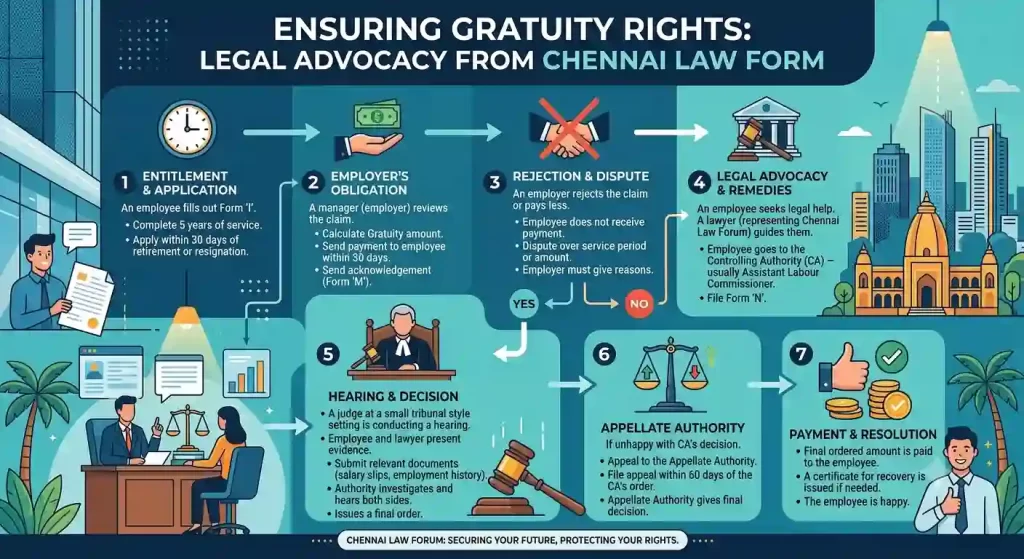
Employees can challenge delayed, denied, or incorrectly calculated gratuity through statutory labour remedies. First, employees should submit a written demand with service and salary evidence. Next, they should approach the competent authority if the employer fails to resolve the dispute. The gratuity framework provides statutory mechanisms for determining and recovering payable amounts. (Labour Government of India) Moreover, certain gratuity protections restrict attachment against qualifying amounts through court orders. (Labour Government of India) Forfeiture also requires careful examination because employers cannot arbitrarily cancel statutory benefits.
Therefore, disciplinary allegations require separate legal analysis before forfeiture becomes sustainable. Chennai Law Forum can prepare claims, representations, supporting documents, and hearing submissions. We can also assess limitation, interest, settlement possibilities, and appellate remedies. Consequently, early legal intervention can improve recovery prospects and prevent procedural mistakes.
Special Employment Situations
Fixed-Term and Contract Employees
Fixed-Term Employee Gratuity
FTE receives specific gratuity treatment under the Social Security Code. Government FAQs confirm eligibility after one year from the contract’s commencement. (Labour Government of India) Therefore, employers should not automatically impose the traditional five-year requirement on qualifying fixed-term employees. Contract wording should clearly establish commencement, duration, remuneration, and termination provisions. Moreover, payroll systems should identify fixed-term employees separately for accurate statutory calculations.
Employees should preserve appointment contracts, extensions, salary slips, and final settlement statements. Chennai businesses should review employment templates after the Labour Codes commenced. Legal review can identify clauses that conflict with mandatory statutory protections. Consequently, companies can reduce future claims through compliant documentation and payroll controls. Employees can challenge wrongful denial before the appropriate labour authority. Chennai Law Forum provides representation for employees and employers concerning fixed-term gratuity disputes.
Contract Labour and Principal Employers
Gratuity for Contract Workers
Contract labour creates important questions concerning gratuity responsibility and employment relationships. Government guidance states that the contractor bears gratuity liability under Section 53 of the Social Security Code. (Labour Government of India) Therefore, workers should identify their statutory employer before filing a gratuity claim. Principal employers should maintain contractor agreements, deployment records, attendance details, and statutory compliance documents. Moreover, contractual indemnities cannot automatically eliminate statutory responsibilities toward eligible workers.
Disputes can arise when contractors disappear, deny service continuity, or withhold final benefits. Employees should therefore preserve identity cards, wage slips, attendance records, and deployment evidence. Chennai Law Forum can examine principal employer, contractor, and worker relationships carefully. We can assist with representations before competent labour authorities and appropriate appellate forums. Consequently, early intervention can prevent jurisdictional confusion and improve recovery strategy.
Gratuity Disputes, Forums and Legal Representation
Litigation Strategy for Gratuity Claims
Labour Authorities and Adjudication
Appropriate Forum for Gratuity Disputes
Gratuity disputes ordinarily require proceedings before the competent labour authority under applicable social security legislation. Therefore, employees should identify the jurisdiction based upon establishment location and governing rules. Chennai disputes may involve appropriate Tamil Nadu labour authorities and designated gratuity adjudication mechanisms. The forum depends upon employment category, statutory coverage, and the nature of the dispute. Moreover, appellate remedies may arise after an adverse determination. Employees should avoid filing proceedings before unrelated civil forums without legal assessment.
The CPC may apply only where a separate civil dispute independently falls within civil jurisdiction. Consequently, statutory labour remedies should receive priority for gratuity entitlement disputes. Chennai Law Forum can determine jurisdiction before preparing a claim or appeal. We can also advise employers facing proceedings before labour authorities. Proper forum selection prevents dismissal, delay, additional costs, and limitation problems.
Appeals and Higher Courts
Labour Appeals and Judicial Review
An aggrieved party may pursue statutory appellate remedies after receiving an adverse gratuity determination. Therefore, legal counsel should review the order immediately after receipt. Important issues include jurisdiction, service calculation, wage components, evidence, limitation, and procedural fairness. High Courts can exercise constitutional jurisdiction in appropriate cases involving serious legal or procedural errors. However, parties should normally pursue available statutory remedies before seeking extraordinary writ relief. The Supreme Court can consider appropriate appeals involving substantial questions of law.
Moreover, employment disputes may overlap with industrial relations proceedings requiring separate strategy. Chennai Law Forum can assess whether an appeal, writ petition, settlement, or recovery action offers the strongest remedy. We also examine documentary evidence under the Bharatiya Sakshya Adhiniyam, 2023. Consequently, carefully structured litigation can protect both employee entitlements and employer interests.
Evidence, Compliance and Legal Support
Building a Strong Gratuity Case
Essential Documents and Evidence
Strong documentation often determines the success of a gratuity dispute. Employees should preserve appointment letters, salary slips, bank statements, attendance records, and resignation communications. Employers should maintain payroll registers, service records, nomination forms, and payment calculations. Furthermore, electronic evidence can establish employment duration and communications concerning unpaid gratuity. The Bharatiya Sakshya Adhiniyam, 2023 now governs evidence principles applicable to relevant proceedings. Therefore, parties should preserve original electronic records and reliable supporting documentation. Emails, messaging records, digital salary statements, and HR communications may prove important facts.
Chennai Law Forum can examine evidence before initiating proceedings or responding to claims. We can identify missing documents and recommend legally appropriate methods for proving disputed facts. Consequently, early evidence preservation can substantially strengthen negotiation and litigation strategies. Parties should avoid deleting or altering potentially relevant employment records.
Employer Compliance and Preventive Advice
Corporate Gratuity Compliance
Companies should establish systematic gratuity compliance procedures following the Labour Codes’ implementation. Government materials confirm significant changes affecting wage calculations and social security benefits. (Labour Government of India) Therefore, employers should review payroll structures, employment contracts, and fixed-term arrangements. HR teams should periodically reconcile employee service records with statutory gratuity calculations. Moreover, companies should update policies governing resignation, retirement, death, termination, and final settlements.
Contract staffing arrangements require separate review because contractors carry statutory gratuity responsibilities. (Labour Government of India) NGOs, charitable institutions, and other establishments should similarly assess statutory coverage. Legal audits can identify underpayment risks before employees commence proceedings. Chennai Law Forum can review employment policies, agreements, payroll practices, and dispute-resolution procedures. Consequently, preventive compliance reduces interest exposure, penalties, litigation expenses, and operational disruption.
Employee and NRI Legal Assistance
Support for Employees Living Abroad
NRIs may face difficulties recovering gratuity when employers delay payment after overseas relocation. Therefore, legal representation can help manage proceedings without repeated physical attendance in India. Employees should preserve Indian employment records, bank details, appointment documents, and employer correspondence. Moreover, a properly authorised representative can assist with appropriate legal procedures. Chennai Law Forum can examine employment history and determine applicable gratuity rights.
We can coordinate notices, authority proceedings, documentation, and eligible appellate remedies. Cross-border employment arrangements may require additional analysis concerning the actual Indian employer and employment location. Consequently, NRIs should obtain advice before signing final settlements or releasing statutory claims. Digital communication and electronic evidence can support many factual aspects of employment disputes. Our legal team can also assess whether contractual disputes require separate civil or commercial remedies.
Criminal Allegations and Police Issues
BNS, BNSS and Police Complaints
Gratuity disputes ordinarily remain labour-law matters rather than ordinary criminal cases. However, separate allegations may arise involving fraud, forged records, criminal breach of trust, or dishonest conduct. The Bharatiya Nyaya Sanhita, 2023 governs substantive criminal offences after replacing the Indian Penal Code. The Bharatiya Nagarik Suraksha Sanhita, 2023 governs criminal procedure and related police processes. Therefore, parties should distinguish employment claims from genuinely criminal allegations. A nearby Chennai police station cannot determine ordinary statutory gratuity entitlement. Instead, competent labour authorities generally handle gratuity adjudication and recovery.
Nevertheless, criminal proceedings may require separate representation where independent offences genuinely arise. Chennai Law Forum can coordinate employment, civil, commercial, and criminal legal strategies where necessary. Consequently, clients should avoid making unsupported criminal allegations merely to pressure settlement. Evidence should remain accurate, relevant, authentic, and legally defensible throughout proceedings.
Chennai Law Forum Legal Representation
Comprehensive Gratuity Advocacy
Chennai Law Forum provides legal support for employees, employers, NGOs, companies, contract workers, and NRIs. Our services cover gratuity eligibility, calculation disputes, delayed payments, forfeiture, and service-continuity questions. We also review fixed-term employment and contract-labour arrangements under the current Social Security Code. Government guidance confirms the Code’s gratuity provisions operate from 21 November 2025. (Labour Government of India) Furthermore, we assist with notices, representations, authority proceedings, appeals, and suitable High Court remedies.
Our lawyers can examine employment records and electronic evidence before selecting litigation strategy. We also advise companies on preventive compliance and contractual risk management. Consequently, clients receive practical guidance focused on recovery, compliance, negotiation, and litigation. The legal remedy depends upon facts, jurisdiction, evidence, statutory coverage, and applicable limitation periods. Professional advice should therefore precede settlement, waiver, or commencement of proceedings.
Frequently Asked Questions
1. Who qualifies for gratuity under current Indian labour law?
Eligible employees generally require five years’ continuous service. However, special rules apply to death, disablement, and qualifying fixed-term employment under the Social Security Code.
2. Does the five-year rule apply to fixed-term employees?
No. Government guidance states qualifying fixed-term employees become eligible after completing one year from contract commencement.
3. Who pays gratuity for contract labour?
The Ministry’s guidance states the contractor bears gratuity liability under Section 53 of the Social Security Code.
4. Can an employer deny gratuity after resignation?
An employer cannot deny lawful gratuity merely because employment ended through resignation. Eligibility, service, wage calculation, and statutory forfeiture provisions require examination.
5. Where can Chennai employees challenge unpaid gratuity?
Employees can approach the competent labour or gratuity authority having jurisdiction. Appeals and appropriate High Court remedies may follow statutory requirements.
6. Can NRIs pursue unpaid gratuity from abroad?
Yes. NRIs can obtain legal representation in India, subject to applicable procedures, documentation, jurisdiction, limitation, and authorisation requirements.
Read More
- Advocating in Governmental Affairs: Legal Support from Chennai Law Forum
- Legal Services for Government Contractors: Chennai Law Forum Expertise
- Drafting Gift Deeds: Expert Legal Assistance in Chennai
- Fighting Fraud Cases: Legal Advocacy from Chennai Law Forum
- Legal Support for Franchise Agreements: Chennai Law Forum Guidance
- Ministry of Labour & Employment, Government of India