
Drafting Gift Deeds – A gift deed records a voluntary transfer of property without monetary consideration. Under the Transfer of Property Act, 1882, a gift requires acceptance during the donor’s lifetime. Immovable property gifts require a registered instrument signed by the donor and attested by witnesses. Therefore, proper drafting protects both donor and donee from future disputes. The deed should clearly identify the property, parties, relationship, consideration, possession, and transfer intention. Additionally, it should state whether the gift carries conditions legally capable of enforcement.
Chennai property owners should verify title documents before preparing any gift deed. Moreover, lawyers should examine encumbrances, prior transfers, mortgages, family claims, and revenue records. A carefully drafted document can reduce registration objections and future litigation. Consequently, professional legal assistance remains valuable for residential, commercial, agricultural, and inherited properties.
Drafting Gift Deeds: Expert Legal Assistance in Chennai – Chennai Law Forum
Essential Elements of a Valid Gift
A valid gift deed requires clear compliance with statutory requirements and factual circumstances. The donor must act voluntarily without coercion, fraud, undue influence, or incapacity. The donee must accept the gift during the donor’s lifetime. Furthermore, immovable property transfers require registration under applicable law. The document should accurately mention:
- Full names and addresses of donor and donee.
- Property description and boundaries.
- Title and ownership details.
- Nature of the gift and acceptance.
- Possession arrangements.
- Witness particulars and signatures.
Additionally, stamp duty and registration charges must follow Tamil Nadu requirements. Therefore, parties should verify current rates before execution. A lawyer can identify drafting defects before registration. Proper verification also helps prevent disputes involving multiple heirs or co-owners. Consequently, legal review provides greater certainty regarding ownership and future enjoyment.
Donor and Donee Rights
The donor transfers ownership voluntarily while the donee accepts the transferred property. However, the deed should define possession and enjoyment clearly. A donor may sometimes reserve specific rights where legally permissible. Nevertheless, restrictive conditions require careful drafting because unlawful conditions can create disputes. The donee should understand liabilities associated with the property before acceptance. Additionally, parties should consider existing mortgages, leases, litigation, taxes, and statutory restrictions. Family gifts require particular attention because future inheritance disputes may arise.
Therefore, lawyers should examine the donor’s title and capacity before drafting. They should also confirm whether any power of attorney affects the proposed transfer. Furthermore, legal advice can explain consequences under succession and property laws. A properly executed deed can establish strong documentary evidence of the intended transfer. Consequently, parties should avoid using generic online templates without professional review.
Drafting, Registration and Legal Protection
Property Verification Before Drafting
Title Investigation and Encumbrance Checks
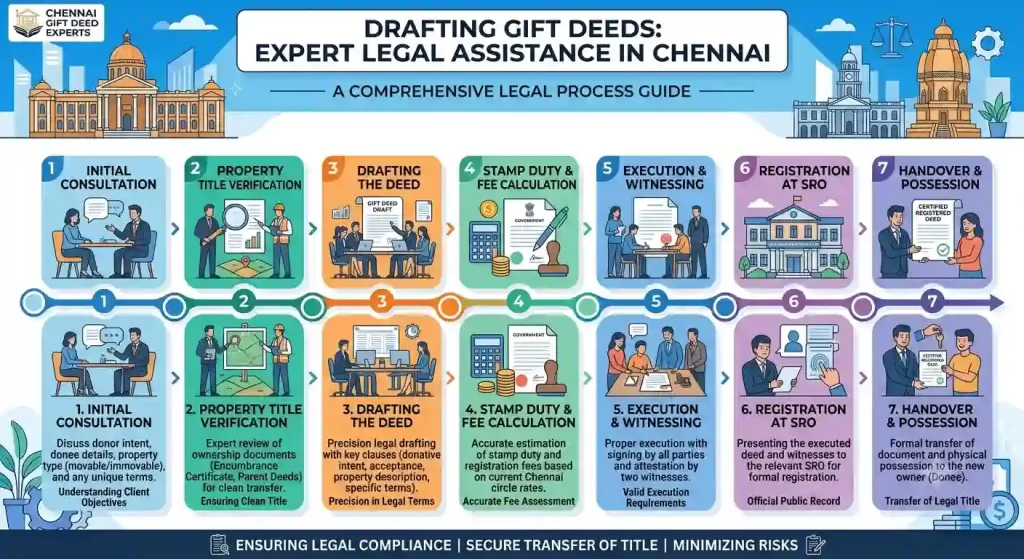
A gift deed should follow a proper title investigation rather than merely describe the property. Lawyers examine parent documents, previous sale deeds, partition deeds, settlement deeds, wills, and gift deeds. They also review encumbrance certificates for registered transactions affecting the property. Additionally, revenue records can reveal patta, subdivision, classification, and ownership information. Chennai properties may require verification with relevant registration and revenue authorities.
Therefore, lawyers should compare documentary title with the property’s actual possession. They should identify mortgages, attachments, pending litigation, acquisition notices, or third-party interests. Furthermore, municipal records may require verification for buildings and property assessments. A detailed title search helps identify defects before registration. Consequently, parties can correct ownership issues before completing the gift transaction. This process also reduces the risk of future civil suits seeking cancellation or declaration.
Registration in Tamil Nadu
Registration provides important legal evidence for qualifying transfers of immovable property. The Sub-Registrar Office having appropriate jurisdiction generally handles registration of the gift deed. Parties should present the executed document with required identification and supporting records. Additionally, applicable stamp duty and registration charges must be paid. Tamil Nadu’s registration authorities may prescribe procedures, forms, and supporting requirements. Therefore, parties should verify current rules before attending the registration office. Lawyers can coordinate document preparation, appointment procedures, identification requirements, and registration formalities.
Furthermore, witnesses should remain available as required for execution and registration. After registration, parties should obtain and preserve the registered document and relevant receipts. Consequently, proper registration strengthens evidence of the completed transfer. Any refusal or objection from the registration authority should receive prompt legal attention.
Stamp Duty and Registration Charges
Gift deeds attract stamp duty and registration charges according to applicable state law. Tamil Nadu provides specific treatment for certain gifts between specified family members. However, rates and concessions can change through legislation, notifications, or government orders. Therefore, parties should verify the current charges before executing the document. Lawyers can examine the relationship between donor and donee for applicable concessions. They can also assess property classification, market value, and registration jurisdiction.
Additionally, underpayment may create registration complications and additional financial liabilities. Consequently, accurate valuation remains important during document preparation. Parties should retain payment receipts and registration records after completing the transaction. Moreover, legal professionals can explain the difference between stamp duty and registration fees. They can also identify potential tax consequences arising from the transfer. Thus, proper financial planning should accompany gift deed drafting.
Family and Property Dispute Prevention
Gifts Between Family Members
Family gifts can simplify succession planning but may also generate disputes among relatives. Parents frequently transfer properties to children, spouses, or other close family members. However, such transfers require careful consideration of existing family arrangements. Lawyers should examine whether the property remains self-acquired or involves ancestral or jointly owned interests. Additionally, the donor’s intention should remain clear and independently documented. Questions concerning maintenance rights can also arise under applicable personal and welfare laws.
Therefore, elderly donors should receive independent legal advice before executing significant transfers. Courts may scrutinise allegations involving coercion, fraud, incapacity, or undue influence. Furthermore, medical evidence can become relevant where capacity is disputed. A carefully drafted deed can record voluntary intention and acceptance. Consequently, transparent execution can reduce later allegations of manipulation or improper influence.
Cancellation and Revocation Issues
Gift deed cancellation requires careful examination because completed gifts generally receive strong legal protection. The Transfer of Property Act permits revocation in specified circumstances rather than unrestricted cancellation. Therefore, parties should not assume that donors can cancel gifts whenever relationships deteriorate. Lawyers should examine the deed’s conditions and surrounding circumstances. Additionally, allegations of fraud, coercion, undue influence, or defective acceptance can affect validity. Courts may consider civil suits seeking appropriate declarations, cancellation, or related reliefs.
Consequently, a donor facing a disputed gift should obtain immediate legal advice. A donee should similarly defend ownership using the registered deed and supporting evidence. Furthermore, revenue mutation does not alone determine legal title. Parties should distinguish registration, mutation, possession, and ownership consequences. Proper legal strategy can prevent contradictory claims before different authorities and courts.
Tax and Succession Considerations
Gift transactions can create tax and succession implications requiring separate professional assessment. Income-tax treatment depends upon the relationship, property type, transaction circumstances, and applicable provisions. Therefore, parties should examine tax consequences before executing the deed. Gifts may also influence future inheritance expectations and family settlements. Additionally, stamp duty treatment depends upon Tamil Nadu law and applicable notifications. Lawyers should coordinate with tax professionals when substantial assets are involved.
Furthermore, NRIs gifting Indian property require additional attention to foreign exchange and tax requirements. Companies and trusts may face different legal considerations when transferring assets. Consequently, parties should not treat every gift deed as a simple family transaction. Proper planning can reduce unexpected liabilities and future disputes. A comprehensive review should consider property law, registration law, tax law, succession, and applicable regulatory requirements.
Courts, Remedies and Legal Support
Civil Courts and CPC Remedies
Gift deed disputes commonly involve declarations, cancellation, injunctions, possession, or title-related claims. Civil courts can adjudicate appropriate property disputes according to jurisdiction and applicable law. The Code of Civil Procedure, 1908 governs civil procedure, including pleadings, evidence, interim relief, and appeals. Additionally, Order XXXIX CPC may become relevant for temporary injunction applications. Therefore, parties facing threatened alienation or interference should seek prompt legal advice. Lawyers can examine limitation, territorial jurisdiction, pecuniary jurisdiction, and necessary parties.
Furthermore, registered documents can form important evidence during civil proceedings. Courts may also consider surrounding circumstances concerning execution and acceptance. Consequently, litigation strategy should focus on the precise relief and supporting evidence. Parties should avoid relying solely upon revenue records or informal family arrangements. A Chennai property lawyer can formulate suitable pleadings and interim protection strategies.
Police Complaints and Criminal Allegations
Some gift deed disputes may involve allegations of forgery, cheating, criminal breach, or document manipulation. Such allegations require separate evaluation under India’s current criminal-law framework. The Bharatiya Nyaya Sanhita, 2023 contains substantive criminal offences, while BNSS governs criminal procedure. The Bharatiya Sakshya Adhiniyam, 2023 governs evidence under the new framework. Therefore, genuine criminal conduct may require a complaint before the appropriate police station. However, a simple civil ownership dispute does not automatically become a criminal offence.
Lawyers should distinguish contractual, property, registration, and criminal issues carefully. Additionally, electronic communications and digital documents may become relevant evidence. Consequently, parties should preserve original documents and electronic records without alteration. Police proceedings and civil litigation can sometimes proceed separately where legally justified. Proper legal advice prevents exaggerated allegations and protects legitimate property rights.
Registration Authorities and Appeals
The registration process involves statutory duties performed by registration authorities under applicable law. Parties may face objections concerning valuation, execution, identity, jurisdiction, or document requirements. Therefore, they should obtain written reasons for significant registration refusals or objections. Lawyers can examine available statutory remedies against administrative registration decisions. Additionally, the Inspector General of Registration and other competent authorities may exercise powers under applicable registration law. Chennai parties should identify the correct office based on property location.
Furthermore, legal counsel can prepare representations, appeals, or judicial challenges where appropriate. Administrative remedies should follow the governing statute and applicable procedural requirements. Consequently, parties should not delay after receiving adverse registration communications. Proper legal representation can also prevent repeated visits and incomplete submissions. The objective remains lawful registration supported by accurate documents and evidence.
Drafting Mistakes to Avoid
Gift deeds often fail to address practical issues that later create expensive disputes. Common mistakes include vague property descriptions, incorrect survey numbers, missing boundaries, and incomplete title references. Additionally, parties sometimes overlook existing mortgages, litigation, tenants, or co-owner interests. Another problem involves unclear acceptance, possession, or reserved rights. Therefore, lawyers should verify every material fact before finalising the document. They should also avoid contradictory clauses concerning ownership and future control.
Furthermore, signatures, witness details, identification documents, and registration formalities require careful checking. A deed should use precise language without unnecessary conditions or ambiguous promises. Consequently, professional drafting can reduce interpretive disputes and registration objections. Parties should also maintain certified copies and supporting title documents after registration. Proper document management becomes especially important when properties pass through multiple generations.
Legal Support from Chennai Law Forum
Chennai Law Forum provides legal assistance for drafting and reviewing gift deeds involving Chennai properties. Our lawyers can conduct title verification, document review, clause drafting, and registration guidance. Furthermore, we can identify family disputes, ownership defects, encumbrances, and potential litigation risks. Our support can cover residential, commercial, agricultural, inherited, and jointly owned properties. We can also advise donors, donees, NRIs, families, trusts, and other eligible property holders.
Additionally, our team can assist with registration objections, civil disputes, injunctions, declarations, and cancellation proceedings. Where genuine criminal allegations arise, we can coordinate appropriate BNS and BNSS legal strategies. Therefore, our approach considers the complete legal position rather than only document preparation. Clients receive practical guidance concerning jurisdiction, evidence, government authorities, courts, and available remedies. Early legal review can prevent avoidable disputes after registration. Consequently, professional drafting offers stronger protection for valuable property transfers.
Frequently Asked Questions
What is a gift deed?
A gift deed legally records voluntary property transfer without consideration. Immovable property gifts generally require registration, donor execution, witness attestation, and acceptance.
Can parents gift property to children?
Yes. Parents can generally gift eligible property to children, subject to ownership, registration, stamp duty, tax, succession, and other applicable legal requirements.
Can a gift deed be cancelled?
Cancellation depends on statutory grounds and transaction circumstances. A donor cannot ordinarily revoke a completed gift merely because relationships subsequently deteriorate.
Is registration mandatory for property gifts?
Yes. Gifts of immovable property generally require registration under the Transfer of Property Act and applicable registration laws.
Can NRIs execute gift deeds in Chennai?
Yes. NRIs can gift eligible Indian property, subject to applicable property, registration, tax, FEMA, identification, and power-of-attorney requirements.
What remedies exist against a disputed gift deed?
Depending on facts, parties may seek declaration, cancellation, injunction, possession, appeal, registration remedies, or appropriate civil and criminal proceedings.
Read More
- Fighting Fraud Cases: Legal Advocacy from Chennai Law Forum
- Legal Support for Franchise Agreements: Chennai Law Forum Guidance
- Addressing Foreign Technology Transfer Agreements: Chennai Law Forum Expertise
- Legal Services for Foreign Investment: Expert Assistance from Chennai Law Forum
- Expert Assistance for Foreign Exchange Management Act (FEMA) Matters
- Tamil Nadu Registration Department – TNREGINET