

Guardianship Legal Services – Guardianship protects the personal welfare, education, property, and legal interests of minors. In Chennai, guardianship disputes often arise after separation, parental conflict, death, or family disagreements. The Guardians and Wards Act, 1890 remains a central statute for court-appointed guardianship. The Hindu Minority and Guardianship Act, 1956 supplements guardianship law for Hindus. It addresses natural guardianship, testamentary guardianship, and guardian powers. However, courts always prioritize the child’s welfare over competing parental claims.
Therefore, guardianship is not merely about parental status or inheritance rights. Courts examine living arrangements, education, health, safety, emotional stability, and family circumstances. Consequently, strong evidence and carefully drafted pleadings become essential. Chennai Law Forum assists parents, relatives, and other eligible applicants with guardianship petitions. Our legal support covers consultation, documentation, filing, hearings, interim relief, and appeals.
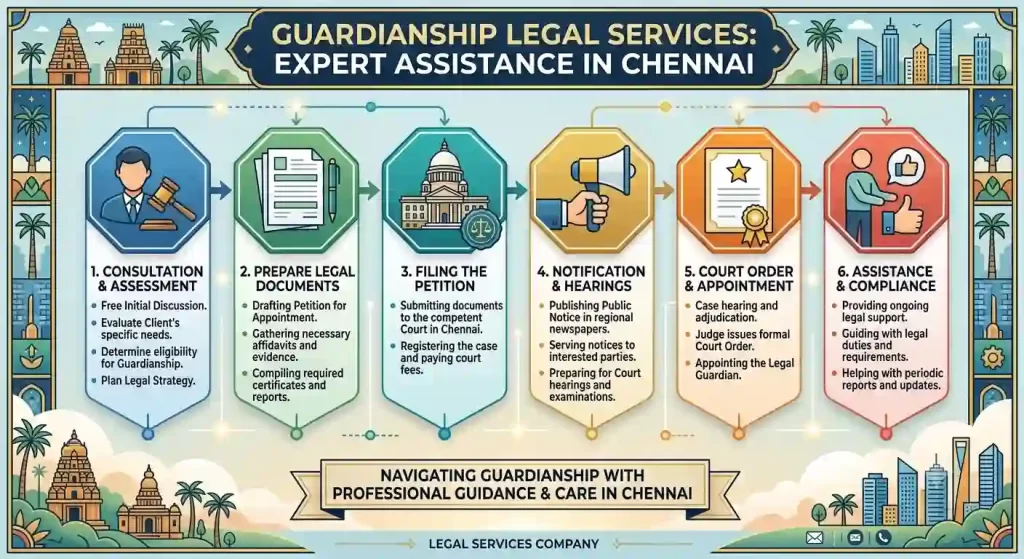
Guardianship Legal Services: Expert Assistance in Chennai – Chennai Law Forum
Who Can Seek Guardianship
Parents commonly seek guardianship, but other relatives may also approach competent courts. Grandparents, adult relatives, and suitable persons may seek appointment where circumstances justify intervention. The court evaluates the applicant’s suitability and the child’s welfare before granting relief. Under the Hindu Minority and Guardianship Act, statutory provisions identify natural guardians for Hindu minors. Nevertheless, statutory status does not guarantee custody or guardianship in every dispute. Courts examine facts surrounding the child’s best interests.
Therefore, applicants should present evidence showing stability, responsibility, and genuine concern for the minor. School records, medical documents, residence evidence, financial records, and communication history can become relevant. Moreover, allegations concerning neglect, abuse, coercion, or parental misconduct require careful legal handling. Chennai Law Forum helps applicants identify the correct legal remedy and supporting evidence. Early advice can prevent procedural mistakes and strengthen the guardianship petition.
Guardianship of Minor Property
Guardianship may involve property management when a minor owns movable or immovable assets. Property guardians must protect the minor’s financial interests and comply with statutory restrictions. The Hindu Minority and Guardianship Act restricts certain transactions involving a minor’s immovable property. The Guardians and Wards Act also regulates court-appointed guardians and their responsibilities. Therefore, parents or relatives should obtain legal advice before selling, mortgaging, leasing, or otherwise dealing with minor-owned property.
Courts may require permission for transactions affecting the minor’s property interests. Consequently, undocumented property arrangements can create future litigation and financial risks. Chennai property guardianship disputes may involve registration authorities, revenue records, banks, or other agencies. Our lawyers can examine title documents, inheritance records, settlement deeds, wills, and existing court orders. We also assist with applications seeking lawful permission for necessary property transactions.
Chennai Courts and Jurisdiction
Choosing the Correct Forum
Family Court Jurisdiction in Chennai
The appropriate forum depends upon the nature of the guardianship dispute and applicable jurisdictional rules. Chennai has specialized Family Court mechanisms for several family-related proceedings. The Family Courts Act, 1984 establishes the statutory framework for Family Courts and their jurisdiction. Guardianship disputes may also proceed under applicable provisions before the competent court. Therefore, parties should identify jurisdiction before preparing pleadings or seeking interim orders. Territorial jurisdiction can depend upon the child’s ordinary residence and other statutory considerations.
Additionally, matrimonial proceedings may create connected custody or guardianship issues. Consequently, filing before an unsuitable forum can cause delay and additional expense. Chennai Law Forum examines jurisdiction before filing any guardianship petition. Our legal team can assess Family Court, District Court, High Court, or appellate jurisdiction. We also coordinate related matrimonial, maintenance, property, and child-protection proceedings where necessary.
Guardians and Wards Act Procedure
The Guardians and Wards Act provides the principal statutory procedure for many court-appointed guardianship proceedings. The court considers the welfare of the minor while deciding guardianship questions. Applicants must provide material facts concerning the child, proposed guardian, family circumstances, and requested relief. Supporting documents should establish the applicant’s relationship, residence, financial position, and suitability. Moreover, courts may consider the child’s preferences depending upon age and circumstances. Therefore, applicants should avoid exaggerated allegations or irrelevant personal disputes.
Instead, pleadings should focus upon demonstrable welfare concerns and legally relevant facts. Interim applications may seek temporary custody, visitation arrangements, or protective directions. Chennai Law Forum assists with drafting petitions, affidavits, supporting documents, and interim applications. We also prepare clients for hearings and evidence. Proper preparation helps courts receive a clear and coherent guardianship case.
Hindu Guardianship Rules
Hindu guardianship disputes require careful application of the Hindu Minority and Guardianship Act. The Act defines important concepts concerning minors and natural guardians. Section 6 addresses natural guardianship, while Section 8 regulates powers of natural guardians. However, courts do not treat statutory guardianship as an absolute entitlement. The child’s welfare remains central to judicial decision-making. Therefore, disputes involving mothers, fathers, grandparents, or other relatives require fact-specific assessment. Religious personal law may also interact with other applicable statutes and judicial principles.
Consequently, applicants should avoid relying solely upon customary assumptions about parental rights. Chennai Law Forum reviews the child’s circumstances alongside applicable statutory provisions. We provide legal assistance concerning custody, guardianship, visitation, property, education, and welfare. Our approach focuses upon lawful remedies and evidence supporting the minor’s best interests.
Evidence, Interim Relief and Enforcement
Building a Strong Guardianship Case
Documents Required for Guardianship
Effective guardianship litigation begins with accurate documents and a consistent factual record. Applicants should collect the child’s birth certificate, identity documents, school records, and residence evidence. Medical records can become important where health or special-care issues affect guardianship. Financial documents may demonstrate the proposed guardian’s ability to provide stable support. Marriage certificates, divorce orders, prior custody orders, and family settlements can also matter. Furthermore, communication records may help establish visitation difficulties or parental cooperation problems.
Courts may scrutinize allegations concerning neglect, abuse, relocation, or unsafe environments. Therefore, applicants should preserve original records and maintain reliable copies. Digital evidence should retain its original context whenever possible. Chennai Law Forum helps clients organize documents before filing guardianship proceedings. We identify evidentiary gaps and recommend lawful methods for obtaining missing records. This preparation can improve pleadings and reduce avoidable adjournments during hearings.
Interim Custody and Visitation
Parents may require urgent interim arrangements while a guardianship case remains pending. Courts can consider temporary custody and visitation requests according to applicable law. Such applications should explain the immediate circumstances and proposed safeguards clearly. Therefore, applicants should demonstrate why interim relief supports the child’s welfare. Courts may consider school schedules, travel distance, parental availability, and existing relationships. Furthermore, allegations of violence, abuse, intimidation, or parental alienation require careful presentation. Interim orders can establish supervised visitation or structured communication where circumstances warrant.
Chennai Law Forum assists clients seeking temporary custody, visitation schedules, access arrangements, and protective directions. We also help respondents challenge inappropriate or unsupported interim applications. A focused application should avoid unnecessary personal allegations and emphasize practical child-welfare considerations. Consequently, courts can evaluate the requested arrangement without becoming distracted by unrelated matrimonial grievances.
Child Welfare as the Primary Test
Indian guardianship courts generally place the child’s welfare above competing claims of adults. The court may examine emotional, educational, physical, financial, and social considerations. Therefore, parents should build arguments around the child’s actual needs rather than personal grievances. A parent’s income alone does not automatically establish superior guardianship rights. Similarly, gender alone should not determine every guardianship outcome. Courts can examine the child’s relationship with each parent and surrounding family members.
The child’s age and maturity may also influence judicial assessment. Consequently, applicants should present balanced evidence demonstrating stability and responsible parenting. Chennai Law Forum prepares submissions around welfare factors relevant to each individual case. We can address education, healthcare, accommodation, safety, travel, and family support. This evidence-based approach helps the court assess practical outcomes. Moreover, respectful litigation can reduce unnecessary conflict and protect the child’s emotional wellbeing.
Relocation and International Guardianship
International relocation can create complex guardianship and custody disputes involving passports, travel, and foreign residence. NRI parents may require Indian court orders concerning custody or guardianship. Courts can examine whether proposed relocation genuinely serves the child’s welfare. Therefore, travel plans should include accommodation, education, healthcare, financial support, and contact arrangements. Existing custody orders can significantly affect international travel decisions. Additionally, foreign proceedings may create jurisdictional and enforcement questions. Chennai Law Forum assists NRIs and resident parents with cross-border guardianship strategies.
We examine Indian orders, foreign proceedings, travel documents, and proposed visitation arrangements. Where necessary, lawyers can coordinate with overseas counsel regarding connected proceedings. Passport or travel restrictions may require separate applications based upon the facts. Consequently, clients should seek advice before moving a child internationally without appropriate consent or court permission. Early legal planning can reduce emergency litigation and conflicting judicial orders.
Enforcement of Guardianship Orders
A guardianship order requires practical compliance after the court grants relief. A parent may face difficulties when another party ignores custody, visitation, or access directions. Therefore, the affected party should preserve evidence showing each instance of non-compliance. Messages, emails, school records, travel information, and previous court orders can establish relevant facts. Enforcement strategy depends upon the exact terms of the order and applicable procedural law. The Code of Civil Procedure provides the broader procedural framework for civil judicial proceedings.
However, specialized family proceedings may involve additional procedural considerations. Chennai Law Forum can review the existing order and recommend suitable enforcement measures. We also assist with applications concerning modification, compliance, access, or consequential relief. Parties should avoid unilateral action that may undermine the child’s welfare or breach court directions. Instead, lawful enforcement provides a safer and more sustainable remedy.
Legal Remedies and Professional Assistance
Guardianship Disputes and Connected Proceedings
Remedies Available to Parents and Relatives
Challenging an Unfavourable Guardianship Order
An adverse guardianship order does not always end the available legal remedies. Depending upon the order and governing statute, an aggrieved party may have appellate or supervisory remedies. The precise forum depends upon the court that issued the order and applicable procedural provisions. Therefore, clients should obtain the certified order immediately after receiving an adverse decision. Grounds may include legal errors, inadequate consideration of welfare evidence, jurisdictional defects, or procedural irregularities.
However, appellate courts generally examine the record rather than allowing unlimited factual expansion. Consequently, parties should formulate precise grounds supported by documents and evidence. The Code of Civil Procedure contains provisions concerning appeals and related civil procedures. Chennai Law Forum reviews orders and identifies the most appropriate legal route. We assist with appeals, revisions, written submissions, interim applications, and urgent protective relief. Prompt action remains important because statutory limitation periods can restrict available remedies.
Police Complaints and Child Safety Issues
Some guardianship disputes involve allegations requiring separate police or child-protection intervention. Examples include alleged kidnapping, assault, criminal intimidation, abuse, or unlawful retention of a child. Such allegations require careful distinction from ordinary custody disagreements. The Bharatiya Nyaya Sanhita, 2023 now provides India’s principal general criminal code. The Bharatiya Nagarik Suraksha Sanhita, 2023 governs criminal procedure. Therefore, genuine criminal allegations may require appropriate police complaints or criminal proceedings.
The Bharatiya Sakshya Adhiniyam, 2023 governs evidence in applicable criminal proceedings. However, parties should not misuse criminal complaints merely to gain leverage in custody litigation. Chennai Law Forum can help assess whether police, child-protection authorities, or courts require intervention. We also coordinate criminal and family-law strategies when proceedings overlap. Immediate legal advice can help protect children while preserving lawful procedural rights.
Modification of Guardianship Arrangements
Guardianship and custody arrangements may require modification when circumstances materially change. A child’s educational, medical, residential, or family circumstances can evolve over time. Therefore, an existing arrangement may eventually become unsuitable. Courts can consider subsequent developments through appropriate legal proceedings. Examples include parental relocation, repeated visitation failures, changed employment, health concerns, or safety issues. However, applicants should demonstrate genuine changed circumstances rather than ordinary dissatisfaction.
Evidence should connect the changed condition with the requested modification. Chennai Law Forum assists with applications seeking revised custody, visitation, guardianship, or protective arrangements. We review previous orders before recommending further proceedings. This prevents inconsistent pleadings and unnecessary repetitive litigation. Moreover, negotiated arrangements can sometimes reduce conflict where both parents remain cooperative. When settlement fails, focused litigation can protect the child’s interests through appropriate judicial remedies.
High Court and Appellate Remedies
The Madras High Court can become relevant in appropriate guardianship appeals, supervisory proceedings, or constitutional challenges. However, parties should identify the correct statutory remedy before approaching the High Court. Courts generally discourage attempts to bypass effective alternative remedies without adequate justification. Therefore, lawyers should examine the impugned order, procedural history, jurisdiction, and available appeal mechanism. Exceptional circumstances may justify constitutional intervention where serious jurisdictional or procedural issues arise. Chennai Law Forum evaluates these factors before recommending High Court litigation.
We prepare petitions, affidavits, grounds, supporting documents, and interim applications where appropriate. Moreover, connected matrimonial or child-protection proceedings may require coordinated strategy. Parties should avoid filing multiple proceedings containing inconsistent allegations. A unified legal strategy can reduce procedural complications and conflicting orders. Consequently, professional representation becomes particularly important where guardianship litigation reaches appellate or constitutional forums.
Legal Support for Chennai Families and NRIs
Chennai Law Forum provides comprehensive guardianship legal services for parents, relatives, and NRIs. Our assistance begins with factual assessment and jurisdiction analysis. We then identify applicable guardianship laws, personal-law provisions, procedural requirements, and available remedies. Services can include petitions, objections, interim custody applications, visitation matters, property guardianship, appeals, and enforcement. Additionally, we assist clients facing connected matrimonial, criminal, property, or child-protection disputes. NRI clients can receive coordinated guidance for international custody and relocation concerns. Our lawyers also emphasize documentation because reliable evidence strengthens guardianship litigation.
Furthermore, we explain procedural risks before clients make significant decisions involving children. Guardianship disputes require sensitivity because legal conflict can affect a child’s emotional wellbeing. Therefore, our strategy combines firm legal protection with practical child-focused solutions. Chennai Law Forum serves clients seeking guardianship advocates, custody lawyers, Family Court representation, and related legal remedies throughout Chennai.
Frequently Asked Questions
What does a guardianship lawyer do in Chennai?
A guardianship lawyer advises parents or relatives, prepares petitions, handles evidence, seeks interim custody, represents clients in court, and pursues appeals.
Which law governs guardianship of minors?
The Guardians and Wards Act, 1890 provides the general framework. Hindu guardianship matters also involve the Hindu Minority and Guardianship Act, 1956.
Can grandparents seek guardianship?
Yes. Grandparents can approach the competent court where circumstances justify guardianship. The court primarily considers the minor’s welfare and overall best interests.
Can an NRI parent seek guardianship in India?
Yes. An NRI parent may seek appropriate Indian court relief. Jurisdiction, existing orders, residence, and international custody circumstances require careful legal assessment.
Can guardianship orders be challenged?
Potentially, yes. Available appeals or other remedies depend upon the order, issuing court, governing statute, limitation period, and procedural circumstances.
Can police intervene in custody disputes?
Police intervention may arise when genuine criminal allegations or immediate safety concerns exist. Ordinary custody disagreements should generally proceed through appropriate family-law remedies.
Read More
- Ensuring Gratuity Rights: Legal Advocacy from Chennai Law Forum
- Advocating in Governmental Affairs: Legal Support from Chennai Law Forum
- Legal Services for Government Contractors: Chennai Law Forum Expertise
- Drafting Gift Deeds: Expert Legal Assistance in Chennai
- Fighting Fraud Cases: Legal Advocacy from Chennai Law Forum
- Department of Justice – Government of India