

A Chennai Property Dispute may involve title, possession, inheritance, boundaries, encumbrances, construction, family arrangements, or competing transactions.
Next, the first step is to build a document set that explains how the property was acquired.
It should show who claims an interest, what transactions followed, and what the present dispute is.
1. Moreover, start with the title document and earlier records
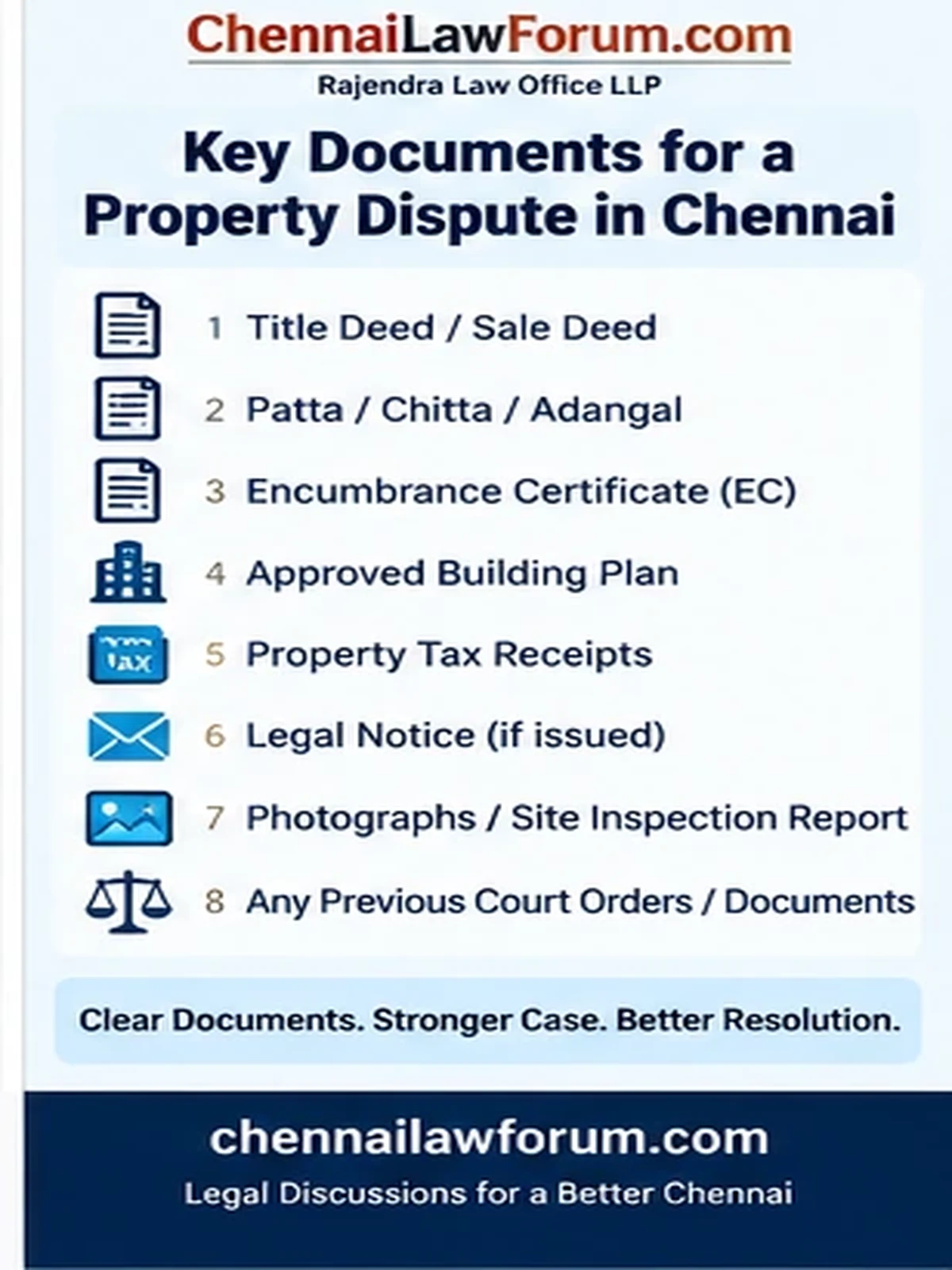
Collect the current sale deed, settlement deed, gift deed, partition deed, or other instrument certifying how title was acquired. Then work backwards through prior deeds where available. A Property Dispute is rarely understood from one isolated document.
2. Additionally, obtain a lien certificate and registration records
An encumbrance record can help trace registered transactions and encumbrances reflected in the registration records for the relevant period. Moreover, it should not be treated as a complete substitute for title due diligence. Additionally, compare the encumbrance records with the actual registered instruments.
Additionally, check Patta, Chitta, Adangal and revenue records where relevant.
Revenue records help explain the revenue position and land details. However, the legal effect of each record depends on the issue. Do not assume that a patta entry alone establishes title. Compare revenue records with registered title documents and the history of possession.
Collect Property Tax and Local-Body Records
Keep property-tax receipts, assessment details, municipal or corporation records and other local-body documents.
These may help establish possession, assessment and the history of use.
Additionally, payment of property tax by itself does not necessarily determine ownership.
5. Gather approved plans and building records
For developed property, collect approved building plans, planning permission, and occupancy records where applicable. Additionally, gather completion records, construction agreements, and relevant local-body communications.
6. Preserve possession evidence
Photographs, electricity and water records, lease agreements, and tenant records may help establish who has been using the property. Additionally, organize these by date rather than as a random collection.
7. Collect family and succession documents when the dispute is inherited property
For family property disputes, obtain death certificates and records related to heirs or succession where applicable.
Include wills, settlement deeds, partition deeds, release deeds, and family arrangements.
Additionally, the applicable personal law, and the date and mode of acquisition, can materially change the legal analysis.
Additionally, identify pending cases, notices, and prior transactions
Search the client’s records for previous legal notices, court orders, civil suits, injunctions, mortgages, and agreements to sell. Additionally, review powers of attorney and other transactions. If a dispute has already reached a court, note the case number. Additionally, place certified copies of material orders at the front of the file.
A Chennai-specific verification habit
Tamil Nadu’s e-Sevai materials show revenue-related services may call for records.
Examples include Chitta, Adangal, Encumbrance, sale deeds, and other supporting documents.
They depend on the service.
Thus, property files should be assembled from multiple record categories.
Therefore, relying on a single certificate is insufficient.
Avoid confusing revenue records with the title
One of the common errors in property disputes is treating a revenue entry as if it answers every title question. Moreover, ownership may depend on the chain of instruments. Statutory rules, succession, prior transfers, court orders and other evidence also matter.
Frequently Asked Questions
Q1. Is an EC enough to prove clear title? No. It is an important due-diligence record, but it should be read with the underlying deeds and other records.
Q2. Does patta prove ownership?
A patta entry can be relevant.
However, it should not be treated as definitive proof of title in every dispute.
Q3. Are property-tax receipts proof of ownership? They can support a factual history of assessment or possession. However, payment of tax alone does not necessarily establish title.
Q4. What should I do if an old deed is missing? Record the missing document and obtain professional advice on certified copies, registration records, and other available evidence.
Conclusion
For a Chennai property dispute, begin with the title chain, registration records, EC, revenue records, tax and approval documents, possession evidence and family/succession records where applicable. The objective is to reconstruct the property’s legal and factual history before deciding whether a notice, negotiation, suit, injunction or another remedy is appropriate.
Internal-Link Opportunities
Add contextual links to relevant existing pages on this website, prioritizing closely related service pages, guides and contact/consultation pages. Use descriptive anchor text and avoid repeating the same exact-match anchor excessively.
Image Placement
Featured image: use the Batch 01 branded featured WEBP. Place the educational infographic after the main explanatory sections/checklist. Use descriptive ALT text based on the image’s actual content; do not keyword-stuff ALT text.
Editorial / Legal Disclaimer
This article is for general legal information and does not constitute legal advice for a specific case. Applicable law, procedure, limitation and jurisdiction can vary with the facts and may change through legislation, rules and judicial decisions. A qualified lawyer should review the individual matter before action is taken.
Sources
Tamil Nadu e-Sevai/TNeGA service information; Registration and revenue records applicable in Tamil Nadu; case-specific property, succession and limitation laws.