

Quick Answer: On 4 September 2026, the Supreme Court of India eCommittee and NALSA launched the first tranche. The Department of Justice joined this launch of Mobile eSewa Vans.
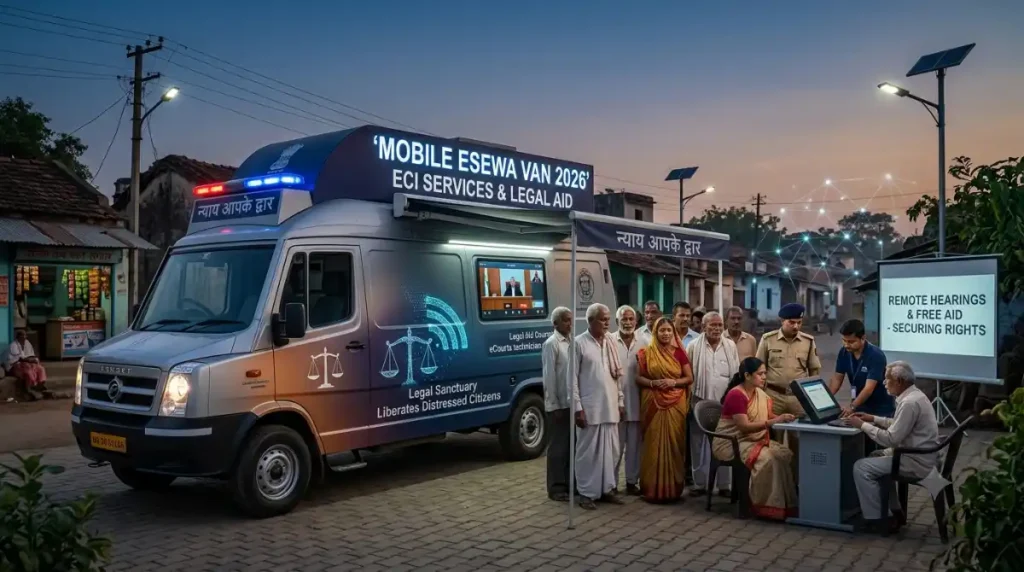
The initiative brings eCourts services, legal aid, dispute resolution support, and legal awareness closer to citizens. It targets people who struggle to access conventional court infrastructure. The first tranche comprised 26 vans, with 73 more planned across designated High Court and District Court jurisdictions.
Read the Supreme Court eCommittee announcement.
Justice on Wheels: How Mobile eSewa Vans are Bringing eCourts to Every Citizen
The initiative is significant because access to justice is not limited to the filing of a case. Citizens may need help checking case status, obtaining orders, understanding digital court services, accessing legal aid, participating in suitable dispute-resolution processes or receiving basic legal information. Mobile digital infrastructure can reduce some of the practical barriers that arise when these services are concentrated in court complexes.
Important: A Mobile eSewa Van is a public-access and facilitation initiative. Chennai Law Forum also provides professional assistance in areas such as governmental and administrative legal matters and fraud-related disputes. It does not replace a lawyer where a person needs individual legal advice, drafting, representation or litigation strategy. Citizens should also verify the services and deployment schedule applicable to their locality before travelling.
1. What Are Mobile eSewa Vans and Why Were They Launched?
The Mobile eSewa Van initiative is an extension of the eCourts Project. The Supreme Court’s 3 September 2026 press note described the initiative as a way to bring eCourts services, legal aid and dispute resolution closer to citizens and to help bridge the digital divide. The first tranche of 26 vans was launched on 4 September 2026, as part of a larger proposed fleet of 73 vans.
Bringing court-related digital services closer to citizens
Many court services are increasingly digital.
Additionally, digital access can be a barrier for people with unreliable connectivity, devices, or digital skills.
A mobile service point like Mobile eSewa Vans can provide practical assistance while connecting citizens with official digital court infrastructure.
Why the digital divide matters in legal services
A person may know that a case exists but still struggle to locate the next hearing date, obtain an order, understand an online filing process or navigate an electronic service. Similar difficulties can affect parties in civil, criminal, family, property, employment and other proceedings. The Mobile eSewa Van model is intended to take selected services beyond permanent court buildings.
Access is more than physical distance
Access to justice can involve physical travel, digital literacy, language, documentation, cost, disability, connectivity and awareness. A service that combines technology with human assistance can address several of these practical barriers, although it cannot remove every legal or procedural requirement.
Why local deployment matters
The Supreme Court announcement states that the vans will be progressively deployed across designated High Court and District Court jurisdictions. Therefore, citizens should not assume that every service is available in every district or on every date. Local deployment information and the specific service schedule should be confirmed through official channels.
What the first tranche includes
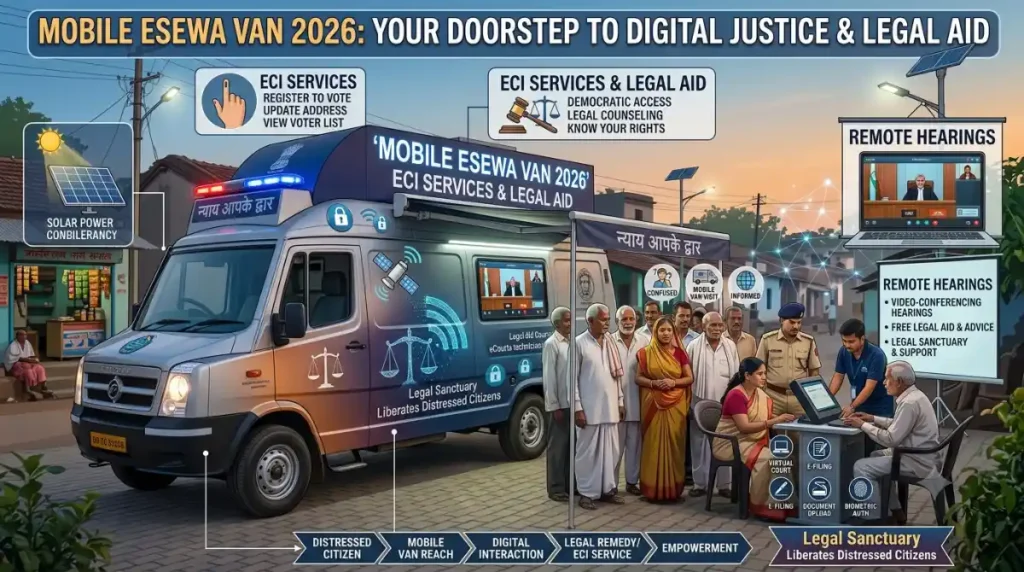
The Supreme Court reported that 26 Mobile eSewa Vans were launched as the first tranche of the larger 73-van plan. The vehicles are equipped for digital connectivity, citizen-facing assistance and video-conferencing functions intended to support remote judicial and legal-service interactions.
Technology and connectivity
The official description refers to high-speed multi-network connectivity, high-definition video-conferencing equipment, displays, power backup and security infrastructure. These features are intended to make the vans functional as mobile service points rather than simply information vehicles.
Video conferencing and remote facilitation
The Supreme Court reported that the system can support remote hearings, witness depositions and other authorised video-conferencing activities. Whether a particular proceeding can be conducted remotely remains subject to the applicable court process, judicial directions and case-specific requirements.
Citizen-friendly access
The vans are designed with citizen access in mind, including seating, audiovisual facilities and digital connectivity. Their role is therefore both technological and service-oriented.
2. What Services Can Citizens Access?
The Supreme Court’s official announcement identifies several categories of services. These include eCourts citizen services, digital filing assistance, secure digital payments, legal-awareness programmes, Mobile Lok Adalats and video-conferencing facilities. The precise service available at a particular location can depend on the deployment and the relevant authority.
eCourts case-status and court information
Citizens can use official eCourts services to obtain information such as case status, hearing dates, orders and judgments. A mobile assistance point can be useful where a person needs help accessing or understanding these digital services.
Case status and next hearing information
Case status information can help a litigant understand whether a matter is pending, listed, disposed of or otherwise updated in the relevant system. A citizen should still rely on the official court record and, where necessary, counsel for procedural advice rather than treating a website entry as a complete legal assessment.
Orders and judgments
Electronic access to orders and judgments can reduce delays in obtaining information. However, where a certified copy is legally required for a particular purpose, the applicable court procedure should be followed.
Digital filing and payment assistance
The initiative includes assistance for e-filing pleadings, applications and appeals and for configuring secure digital payment processes. Digital filing does not remove the substantive requirements of a case: pleadings still need proper facts, legal grounds, documents, verification and compliance with the relevant rules.
What e-filing assistance does not mean
Technical help with uploading a document is different from legal drafting. A person should not assume that assistance with the electronic filing process means that the underlying petition, appeal, application or affidavit has been legally reviewed.
Legal aid and legal awareness
Legal aid is an important part of the initiative. The Supreme Court announcement states that the vans are intended to carry legal aid and legal-literacy programmes into remote and underserved areas. NALSA and the State Legal Services Authorities operate within the statutory legal-services framework for eligible persons.
Who may need legal aid?
Eligibility for free legal services is governed by the Legal Services Authorities Act, 1987 and the applicable rules and schemes. Eligibility should be checked with the relevant Legal Services Authority rather than assumed from financial circumstances alone.
Legal aid is different from private legal representation
Legal aid may provide access to eligible legal services through the legal-services system. A private advocate’s engagement is a separate professional arrangement. Citizens should understand which service they are receiving and whether any professional fee is applicable.
Mobile Lok Adalats and dispute resolution
The official announcement identifies Mobile Lok Adalats and specialised drives for certain disputes as part of the initiative. Lok Adalats are intended to facilitate settlement of matters that are legally capable of settlement. They are not a substitute for adjudication of every type of dispute.
When settlement may be appropriate
Settlement mechanisms can be useful in suitable civil, family, consumer, financial and other matters where the parties have authority to compromise and the subject matter is legally compoundable or otherwise capable of settlement through the relevant process.
Why legal review still matters
A settlement can create binding consequences. Before accepting terms involving property, money, possession, family rights, business obligations or future claims, a party should understand what rights are being surrendered or preserved.
3. What This Means for Chennai Residents and Litigants
The Mobile eSewa Van initiative is national in scope, but the official announcement does not state that a particular van or fixed schedule is already operating at every Chennai location. Chennai residents should therefore distinguish between the national programme and the local deployment information that may subsequently be issued for the relevant jurisdiction.
Chennai’s court ecosystem and digital access
Chennai litigants may interact with the Madras High Court, subordinate civil and criminal courts, tribunals, government authorities and legal-services institutions depending on the dispute. Digital court services can help parties monitor matters without making unnecessary physical trips, but the appropriate court, tribunal or authority depends on the case.
Property, family, employment and civil matters
A litigant dealing with a property, family, employment or civil dispute should first identify the competent forum and the precise relief required. Digital access to case information is useful after that basic legal question has been correctly identified.
Do not confuse information with legal advice
Case-status tools can tell a person what is recorded in the system. They generally cannot tell a person whether a limitation period has expired, whether a pleading is legally sufficient, whether an injunction should be sought or whether a settlement is advisable. Those questions require legal analysis of the facts and applicable law.
Criminal and urgent matters
Criminal proceedings can involve urgent liberty and procedural issues. A citizen should not delay necessary legal assistance merely because a digital service is available. Where arrest, remand, bail, investigation or an immediate court deadline is involved, appropriate legal assistance should be obtained promptly.
Use official information channels
Citizens should avoid relying on unofficial social-media posts, forwarded messages or third-party claims about hearing dates, court orders or legal-aid eligibility. Use official eCourts, court, Legal Services Authority and government sources wherever possible.
4. A Practical Citizen Checklist
If you plan to use a Mobile eSewa Van or another official digital court-service facility, prepare before visiting. This can make the interaction more efficient and reduce the risk of missing important information.
Documents and information to carry
Bring your case number or CNR number if available, names of the parties, court or tribunal details, relevant order dates, copies of important orders, identification documents where required, and a short written description of what assistance you need. If you are seeking legal aid, carry documents relevant to eligibility and the legal issue where available.
For existing court cases
Record the case number, court, next known hearing date and the name of your advocate, if any. Keep copies of recent orders and important pleadings. If the issue is simply accessing official case information, explain that clearly.
For people without a case
If no case has been filed, prepare a concise chronology of events and collect the documents relevant to the dispute. A digital-service point may help with information and access, but it does not necessarily determine whether litigation should be filed.
Protect your personal and legal information
Legal documents often contain Aadhaar details, bank information, addresses, signatures, medical information, property documents and other sensitive data. Share only what is necessary with the authorised service provider and avoid uploading confidential material to unofficial websites or sending it to unknown persons.
Verify who is providing the service
Government and judicial services should be accessed through official channels. Be cautious if anyone asks for payment into a personal account, requests unnecessary credentials or claims that a hearing, warrant or settlement can be guaranteed through a private intermediary.
Keep a record of what was submitted
Where documents are submitted through a digital service, retain acknowledgement numbers, receipts and copies of the material provided. These records can become important if a technical or procedural issue later arises.
5. Frequently Asked Questions
Are Mobile eSewa Vans available everywhere in India?
No. The Supreme Court’s September 2026 announcement describes progressive deployment across designated High Court and District Court jurisdictions. Citizens should verify the local deployment schedule and services before travelling.
Do Mobile eSewa Vans replace lawyers?
No. They provide public-facing eCourts, legal-aid, digital and dispute-resolution services. Individual legal advice, drafting, representation and litigation strategy may still require an advocate.
Can I check my case status through a Mobile eSewa Van?
The official announcement identifies real-time access to eCourts citizen services including case status, next hearing dates, orders and judgment copies. Availability of a particular facility should be confirmed at the local service point.
Can a Mobile eSewa Van help me file a case?
The initiative includes e-filing assistance. However, technical assistance with e-filing is not the same as preparing legally sufficient pleadings or deciding the correct cause of action and relief.
Can a Mobile eSewa Van conduct a court hearing?
The Supreme Court states that the vans have video-conferencing facilities for authorised remote hearings, mediations, witness depositions and other proceedings. Whether a particular hearing can be conducted through the facility depends on the applicable judicial process and directions.
Can I get free legal aid?
Eligible persons may be entitled to legal services under the Legal Services Authorities Act, 1987 and applicable schemes. Eligibility should be checked with the relevant Legal Services Authority.
Can property disputes be settled through a Mobile Lok Adalat?
Some disputes may be suitable for Lok Adalat settlement, subject to the legal requirements governing compromise and the authority of the parties to settle. Not every property dispute can be resolved through a Lok Adalat.
What is the safest source for checking court information?
Use official court and eCourts systems and the relevant Legal Services Authority or government website. The Supreme Court’s official announcement is the primary source for the Mobile eSewa Van programme itself.
Key takeaway: Mobile eSewa Vans represent a practical expansion of digital justice infrastructure. Their significance lies in bringing eCourts access, legal aid, dispute-resolution support and legal awareness closer to people who may otherwise face technological or geographic barriers. For Chennai residents, the next practical step is to verify the official local deployment information and use the service for the functions it is designed to provide, while obtaining separate legal advice whenever the matter requires substantive legal analysis, drafting or representation.
Legal information notice: This article is for general legal education and does not constitute legal advice. Availability of Mobile eSewa Van services, deployment locations, eligibility for legal aid, court procedures and applicable laws may change. Verify current information through official judicial and government channels before acting.
Need individual legal assistance? Chennai Law Forum can assist with legal consultation, drafting, litigation strategy and representation where a matter requires professional legal analysis beyond public digital court services.