
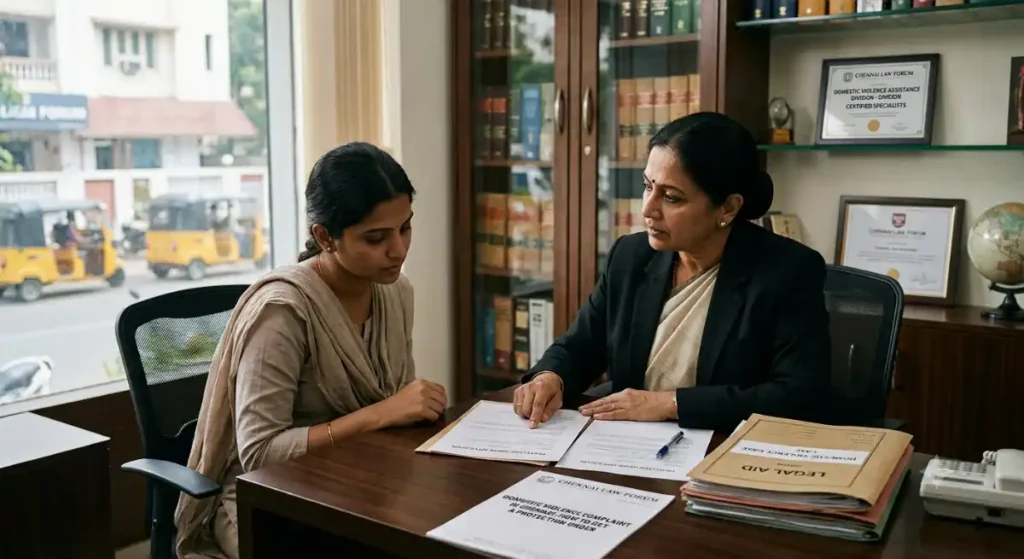
Introduction: A woman facing violence in Chennai can seek protection from Protection Officers, a service provider, or Magistrate’s court. Additionally, this is a civil remedy, distinct from filing a Domestic Violence Complaint (criminal complaint). This guide explains the process step by step for someone in Chennai.
Filing a Domestic Violence Complaint in Chennai: Steps to Secure a Protection Order
What Counts as “Domestic Violence” Under the Act?
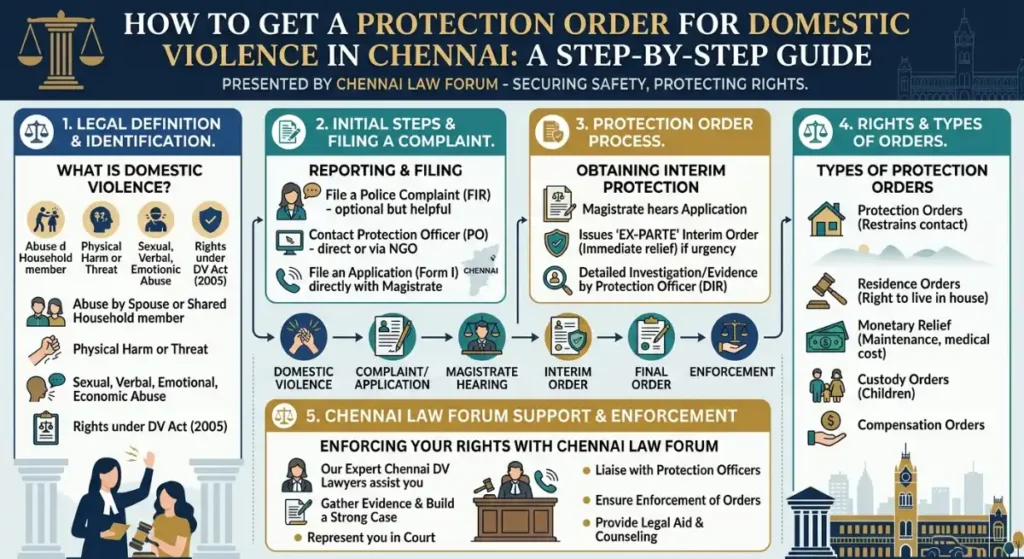
Section 3 of the DV Act defines domestic violence broadly to include physical abuse, sexual abuse, verbal and emotional abuse, and economic abuse — including harassment to coerce dowry or other property. The Act also covers women in a “relationship in the nature of marriage” (live-in relationships), not only legally married women.
Who Can Be Proceeded Against?
The “respondent” is generally any adult male person who is or has been in a domestic relationship with the aggrieved woman. Where the aggrieved person is a wife or a woman in a marriage-like relationship, a complaint can also be filed against relatives of the husband or male partner, including female relatives.
Step-by-Step: What to Do in Chennai –
- Contact a Protection Officer. Under Section 8, every district has designated Protection Officers appointed by the Tamil Nadu government. In Chennai, Protection Officers typically function under the Social Welfare Department, attached to specific Magistrate courts.
- Alternatively, approach the police, a registered service provider (NGO), or a medical facility, all of whom are statutorily required to inform the woman of her rights under the Act and can help route the complaint.
- A Domestic Incident Report (DIR) is prepared, usually with the Protection Officer’s assistance, and forwarded to the jurisdictional Magistrate and police station.
- An application under Section 12 is filed before the Magistrate, either directly or through the Protection Officer, seeking the reliefs required.
- Notice is served on the respondent, and the Magistrate may direct counseling under Section 14 or seek the assistance of a welfare expert under Section 15.
- Proceedings can be held in camera (privately) under Section 16, at the request of either party, given the sensitive nature of the matter.
- The Magistrate passes orders, which may include interim/ex-parte relief where urgency is shown.
What Reliefs Can You Get?
- Protection order (Section 18): Restrains the respondent from committing further acts of violence, contacting the aggrieved person, or aiding others to do so.
- Residence order (Section 19): Under Section 17, every woman in a domestic relationship has the right to reside in the shared household. A residence order can restrain the respondent from dispossessing the aggrieved woman or can direct alternate accommodation.
- Monetary relief (Section 20): Compensation for expenses and losses, including medical costs, loss of earnings, and maintenance for the woman and her children.
- Custody orders (Section 21): Temporary custody of children.
- Compensation order (Section 22): For injury, including mental torture and emotional distress.
Statutory Framework at a Glance
| Section | Subject |
|---|---|
| Section 3 | Definition of domestic violence |
| Section 8 | Appointment of Protection Officers |
| Section 12 | Application to the Magistrate |
| Section 17–19 | Right to reside; residence orders |
| Section 18 | Protection orders |
| Section 20 | Monetary relief |
| Section 31 | Penalty for breach of protection order (criminal offence, up to one year imprisonment and/or fine) |
Breach of a protection order under Section 31 is a cognizable and non-bailable offense, giving these civil remedies real enforcement teeth.
Where to Approach in Chennai
- The jurisdictional Judicial Magistrate/Metropolitan Magistrate court, based on where the aggrieved person resides, where the respondent resides, or where the violence occurred.
- The nearest police station, which is statutorily obligated to inform the woman of her right to apply for reliefs under the Act.
- District Social Welfare Officer / Protection Officer’s office for the concerned zone.
- Registered service providers/NGOs, including One Stop Centers, that assist with documentation, shelter and counseling.
Practical Checklist
- Note down dates, nature of incidents, and any witnesses, as contemporaneously as possible.
- Preserve medical records if there has been physical injury.
- Keep copies of any threatening messages, financial records showing economic abuse, or joint property documents.
- Approach a Protection Officer or the police promptly — do not wait for the situation to escalate before seeking a protection order.
- Consider whether interim/ex-parte relief is needed for immediate safety.
Exceptions and Cautions
- The DV Act provides civil remedies; if the conduct also amounts to an offense under the Bharatiya Nyaya Sanhita (e.g., voluntarily causing hurt, criminal intimidation, cruelty by husband or relatives), a separate criminal complaint may also be filed.
- Proceedings under Section 17, 2005 Act do not by themselves transfer ownership of property; a residence order protects the right to reside, which is distinct from a claim to title.
- This is general information; the specific relief available depends on the facts, evidence and the jurisdictional Magistrate’s assessment.
What Should You Do Next?
If you or someone you know is facing domestic violence in Chennai, reaching out to a Protection Officer or a trusted advocate early can help secure protection orders faster and preserve evidence properly. For urgent safety concerns, the police and local women’s helpline should be contacted immediately, alongside pursuing remedies under the DV Act.
Frequently Asked Questions
Can an unmarried woman in a live-in relationship file under the DV Act?
Yes. The Act covers women in a “relationship in the nature of marriage,” not only legally married women.
Is it necessary to hire a lawyer to approach a Protection Officer?
No. A Protection Officer can assist in filing the application and is required to ensure free legal aid is made available under the Legal Services Authorities Act, 1987, if needed.
Can a woman get both a protection order and monetary relief together?
Yes. The Magistrate can grant multiple reliefs — protection, residence, monetary relief, custody and compensation — in the same or separate applications.
What happens if the respondent violates a protection order?
It is a criminal offense under Section 31, punishable with imprisonment up to one year, a fine, or both, and is cognizable and non-bailable.
Conclusion
However, the DV Act, 2005 gives women in Chennai a practical, relatively fast civil remedy against domestic violence.
Moreover, this Domestic Violence Complaint is backed by criminal consequences for non-compliance.
Acting early—through a Protection Officer, the police, or before a Magistrate—improves the chances of timely protection.
This article provides general legal information only and is not a substitute for advice on your specific circumstances.
Disclaimer
This article is for general legal information only and does not constitute legal advice. Please consult a qualified advocate or approach the nearest Protection Officer/police station for assistance specific to your situation.
Authoritative Sources / References
- Protection of Women from Domestic Violence Act, 2005 — India Code
- Protection of Women from Domestic Violence Rules, 2006
- Tamil Nadu Social Welfare Department — Protection Officer notifications