
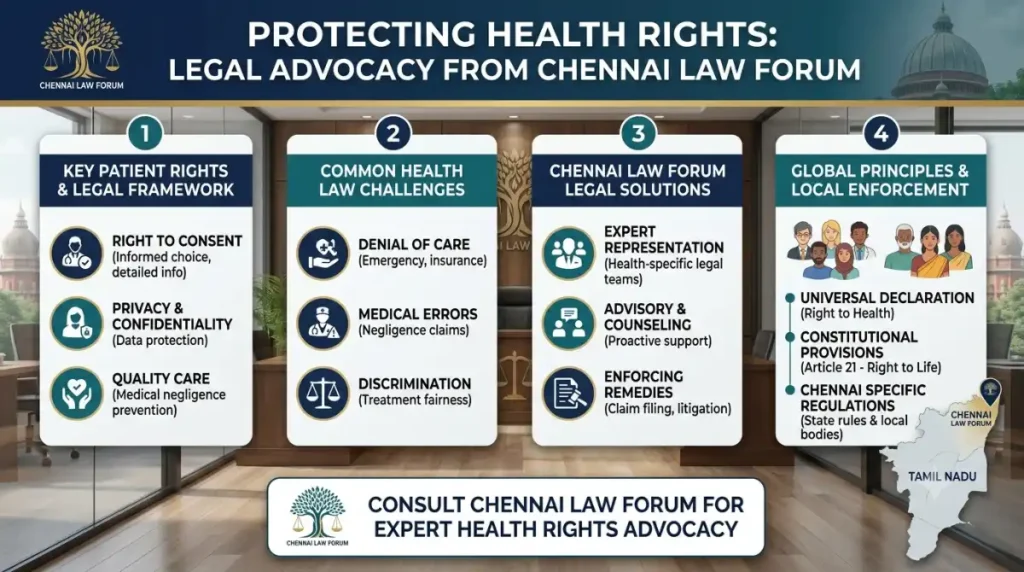
Good health care is not a favour. It is a right that flows from the Constitution of India. Yet many patients in Chennai still face refusal of treatment, hidden charges, wrong diagnosis or careless surgery.
When this happens, the law offers real remedies. This article explains your health rights in simple terms and shows how legal advocacy can protect you.
Safeguarding Human Dignity: Strategic Health Rights Advocacy by Chennai Law Forum
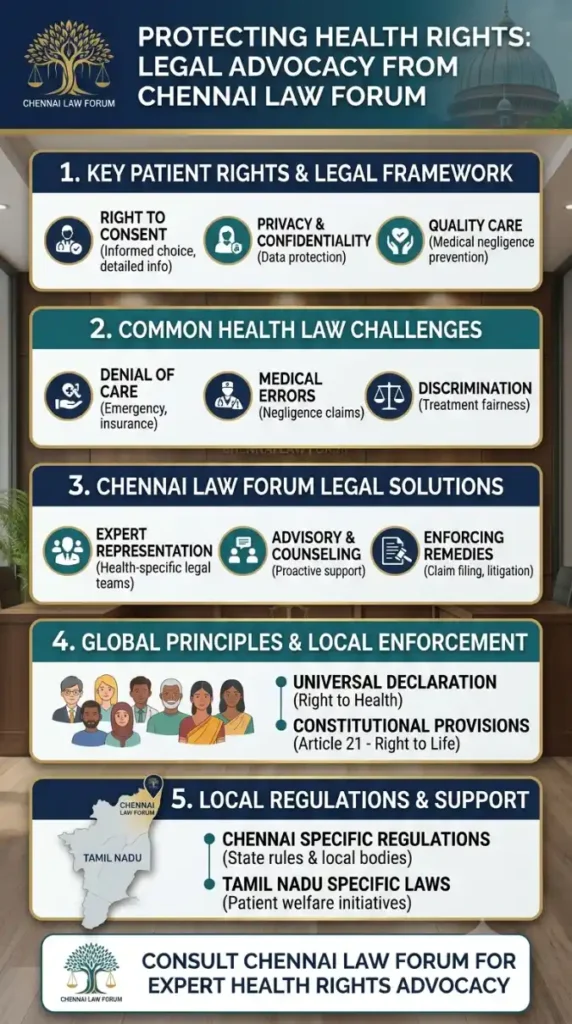
Is the right to health a legal right?
The Constitution does not use the words “right to health”. But the Supreme Court has read it into Article 21, which protects life and personal liberty.
Three principles come from the decided cases:
- The State must provide timely medical aid to a person in need.
- A government hospital cannot refuse an emergency patient for lack of beds or papers.
- Health care is part of a life with dignity.
In Parmanand Katara v. Union of India (1989), the Supreme Court held that every doctor must give emergency aid to an accident victim first. Police formalities can wait. In Paschim Banga Khet Mazdoor Samity v. State of West Bengal (1996), the Court held that denial of emergency treatment in government hospitals violates Article 21.
Core rights of a patient
Patients are not mere recipients of charity. They hold specific rights, even where no single “Patient Rights Act” exists.
- Right to emergency care. No hospital should turn away a person in a life-threatening condition.
- Right to information. You may ask about diagnosis, treatment options, risks and likely cost.
- Right to informed consent. Surgery and major procedures need your consent after proper explanation. The Supreme Court stressed this in Samira Kohli v. Dr. Prabha Manchanda (2008).
- Right to records. You can ask for your case sheet, scans, reports and discharge summary.
- Right to privacy. Your medical details are confidential.
- Right to a second opinion. A hospital cannot force you to stay.
- Right to fair billing. Charges must match what was disclosed and what was actually given.
The National Human Rights Commission has also circulated a Charter of Patients’ Rights. It is not a statute. But it is a useful standard when you raise a complaint.
Laws that protect patients in Tamil Nadu
Several laws work together here.
- Consumer Protection Act, 2019. Medical services for a fee fall within “service”. The Supreme Court settled this in Indian Medical Association v. V.P. Shantha (1995). Free treatment in a government hospital is generally outside this Act, but paid services there are not.
- Tamil Nadu Clinical Establishments (Regulation) Act, 1997. It requires clinics and hospitals to register and meet standards.
- Tamil Nadu Medical Council and the National Medical Commission Act, 2019. They deal with professional misconduct by doctors.
- Mental Healthcare Act, 2017. It protects persons with mental illness and guarantees access to treatment.
- Rights of Persons with Disabilities Act, 2016. It protects equal access to health care.
- Bharatiya Nyaya Sanhita, 2023. Death caused by a negligent act falls under section 106. A registered medical practitioner gets a lower maximum sentence than other persons.
What counts as medical negligence?
Not every bad outcome is negligence. Medicine carries risk. Courts ask a narrow question: did the doctor act below the standard of an ordinarily competent practitioner?
The Supreme Court in Jacob Mathew v. State of Punjab (2005) set a high bar for criminal cases. It required gross negligence or recklessness, and it asked for an independent expert opinion before a doctor is prosecuted.
Common examples that may amount to civil negligence:
- Operating on the wrong site or the wrong patient.
- Leaving a surgical instrument or swab inside the body.
- Missing a clearly visible finding in a scan or report.
- Giving the wrong drug or dose.
- Discharging a patient too early without follow-up advice.
- Treating without consent when no emergency existed.
- Poor infection control that causes avoidable harm.
Step-by-step: what to do if your rights are violated
Act calmly and keep records. Strong documents win these cases.
- Step 1. Secure the records. Ask in writing for the complete file. This includes admission notes, consent forms, nursing charts, operation notes, lab reports and bills. Hospitals must give them on request.
- Step 2. Get an independent medical opinion. Consult another qualified doctor. A written opinion supports your claim.
- Step 3. Send a legal notice. A lawyer drafts a notice stating the facts, the lapse and the compensation sought. Many disputes settle at this stage.
- Step 4. Complain to the regulator. For professional misconduct, you can approach the Tamil Nadu Medical Council. For hospital violations, you can approach the Directorate of Medical and Rural Health Services.
- Step 5. File a consumer complaint. File it before the District Commission through e-Daakhil, or in person. The limitation is two years from the date the cause of action arose.
- Step 6. Consider a criminal complaint. Do this only in cases of gross negligence, forged records or deliberate harm.
- Step 7. Use the writ route where the State is involved. The Madras High Court can order relief under Article 226 against government hospitals and authorities.
Where to file: the right forum
Choosing the correct forum saves time and fees.
- District Commission: consumer claims where the consideration paid is up to ₹50 lakh.
- State Commission: consideration above ₹50 lakh and up to ₹2 crore.
- National Commission: consideration above ₹2 crore.
- Civil court: large damages claims with complex facts, subject to court fee.
- Madras High Court: writ petitions for systemic failures, denial of emergency care or State action.
- Human rights bodies: the Tamil Nadu State Human Rights Commission can take up serious violations in public hospitals.
These pecuniary limits depend on the consideration paid, not on the claim amount. Always verify the current rules before filing.
What compensation can you claim?
A court or commission may award:
- Refund of medical expenses and travel costs.
- Compensation for pain, suffering and mental agony.
- Loss of income during recovery.
- Future medical costs where the harm is permanent.
- Compensation to the family where the patient has died.
- Litigation costs.
The amount depends on age, income, nature of injury and proof. Good medical evidence matters more than emotion.
Hospital billing disputes and insurance problems
Not all disputes involve clinical care. Many involve money.
- Charges that exceed the estimate without explanation.
- Package rates changed after admission.
- Cashless approval denied by the insurer or the hospital.
- Dead body or discharge withheld for unpaid dues.
Holding a patient or a body hostage for dues is wrong. Courts and the NHRC have criticised it. A prompt legal notice and a complaint to the authorities usually resolve this quickly.
For insurance rejections, the Insurance Ombudsman and the consumer commission are available. Our firm handles both.
Special situations
Some cases need extra care.
- Emergency and accident cases. Hospitals must stabilise first. They cannot demand an advance before life-saving aid.
- Maternity and newborn care. Errors here cause lifelong harm. Document the labour records carefully.
- Elderly and bedridden patients. The Maintenance and Welfare of Parents and Senior Citizens Act, 2007 can help where families abandon them.
- Mental health patients. The patient has the right to be treated with dignity and to have a nominated representative.
- Clinical trials and organ donation. Special laws apply, and consent rules are strict.
How Chennai Law Forum helps
Our role is practical. We study the medical file with the help of expert doctors. We tell you honestly whether the case is strong. If it is, we pursue it firmly.
We assist with:
- Review of case sheets and medical records.
- Legal notices to hospitals, doctors and insurers.
- Consumer complaints before District, State and National Commissions.
- Writ petitions before the Madras High Court.
- Complaints to medical councils and human rights commissions.
- Negotiated settlements that save time.
For related issues, you may also read about consumer remedies at ConsumerLawyer.in and general legal support at LawyerChennai.com.
Frequently Asked Questions
Conclusion
Your health rights are real and enforceable. The law protects emergency care, informed consent, privacy and fair treatment. If a hospital or doctor has failed you, quick action and the right documents make all the difference.
Chennai Law Forum provides clear advice and firm advocacy to patients and families. Speak to us before limitation runs out.
Related Reading from Chennai Law Forum
- Consumer protection law and your remedies
- How consumer court cases proceed in Chennai
- Seeking compensation: legal representation in Chennai
- Legal representation for accident claims
- Upholding disability rights
- Protecting elderly rights in Chennai
Need legal advice on this subject? Speak to Chennai Law Forum for a clear, confidential assessment of your matter.
Disclaimer: This article is for general information only. It is not legal advice, and the law and procedure may change. Please consult a qualified advocate before acting on any point discussed here.