
Legal Services for Education Matters – Education is a fundamental right guaranteed under Article 21-A of the Indian Constitution. Chennai Law Forum provides dedicated legal support for education-related disputes across Tamil Nadu. Our senior lawyers handle matters before the Madras High Court, Tamil Nadu State Consumer Disputes Redressal Commission, and various education tribunals. We resolve issues involving school admissions, university disputes, scholarship denials, and institutional misconduct. Furthermore, our team understands the Right to Education Act, 2009 (RTE), UGC Regulations, and AICTE guidelines thoroughly. Every client receives personalised legal counsel tailored to their education matter.
Legal Services for Education Matters: Chennai Law Forum Expertise – Chennai Law Forum: Seniors Lawyers Law Firm
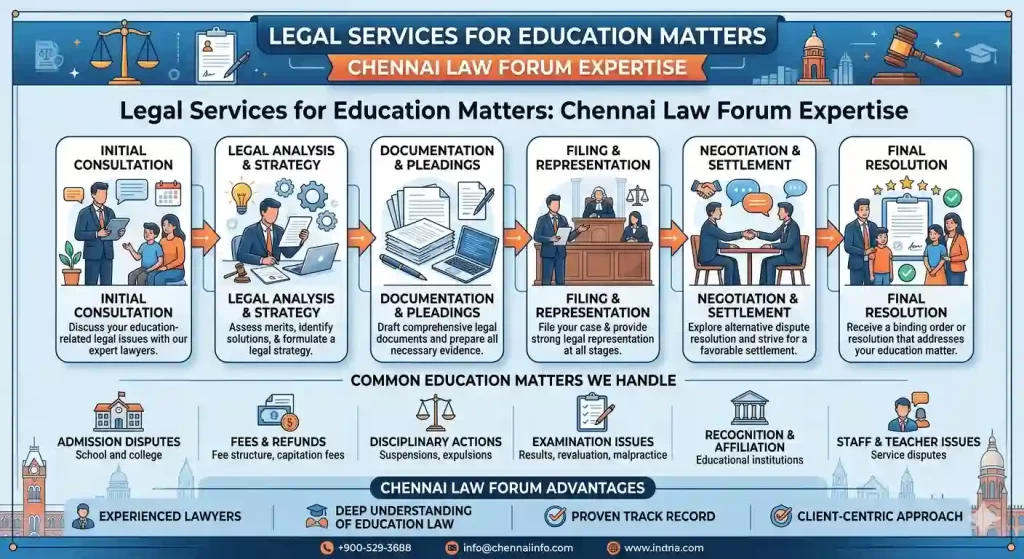
Understanding Education Law in Tamil Nadu: Jurisdiction and Legal Framework
Tamil Nadu has a well-structured legal framework governing educational institutions at every level. Therefore, families and students must understand the applicable laws before pursuing legal remedies. The Right of Children to Free and Compulsory Education Act, 2009 protects children aged 6–14. Additionally, the Tamil Nadu Private Schools (Regulation) Act, 1973 governs private school operations comprehensively. University disputes fall under the Tamil Nadu Universities Act, 1923. Moreover, professional college matters are regulated by AICTE, MCI, and Bar Council norms. The Bharatiya Nagarik Suraksha Sanhita, 2023 (BNSS) governs criminal procedure in complaints against educational institutions. Civil disputes follow the Code of Civil Procedure (CPC), 1908 as amended. The Bharatiya Sakshya Adhiniyam, 2023 (BSA) governs evidence in all legal proceedings. Consequently, engaging a senior education lawyer ensures proper legal forum selection and remedy.
Key Legislation Governing Education Disputes in Chennai
Several central and state laws collectively protect students’ and parents’ rights in Tamil Nadu. Notably, these laws provide both civil and criminal remedies depending on the nature of the dispute. The following key legislations apply to education matters in Chennai and across Tamil Nadu:
| Legislation | Applicability | Forum |
|---|---|---|
| RTE Act, 2009 | Schools (Classes 1–8) | State Commission / HC |
| TN Private Schools Act, 1973 | Private Schools, TN | DGE / Madras HC |
| UGC Act, 1956 | Universities & Colleges | UGC / Madras HC |
| AICTE Act, 1987 | Technical Institutions | AICTE / HC |
| Consumer Protection Act, 2019 | All Fee-Paying Students | DCDRC / SCDRC |
| CPC, 1908 | Civil Education Disputes | Civil Courts |
| BNS, 2023 | Criminal Acts by Institutions | Magistrate Courts |
| BSA, 2023 | Evidence in All Disputes | All Courts / Forums |
Additionally, the Protection of Children from Sexual Offences Act (POCSO), 2012 applies to school-based abuse cases. The Scheduled Castes and Scheduled Tribes (Prevention of Atrocities) Act protects students from caste-based discrimination in institutions. Furthermore, Tamil Nadu Minorities Welfare Department guidelines protect minority-institution students’ rights. The Persons with Disabilities Act and the Rights of Persons with Disabilities Act, 2016 (RPWD) safeguard differently-abled students’ access to inclusive education. These legislative provisions are actively enforced by Tamil Nadu courts. Consequently, knowing the right law for your specific dispute determines success significantly.
Jurisdictional Forums for Education Legal Matters in Chennai
Choosing the correct forum is critical for obtaining timely and effective relief in education disputes. Therefore, Chennai Law Forum’s senior advocates guide clients to the appropriate legal authority. The key forums handling education matters in Chennai and Tamil Nadu include the following:
- Madras High Court – Writs under Articles 226 & 227 for fundamental rights violations
- District Consumer Disputes Redressal Commission (DCDRC), Chennai – Fee disputes, deficiency in service
- Tamil Nadu State Consumer Disputes Redressal Commission (SCDRC) – Appeals and high-value claims
- National Consumer Disputes Redressal Commission (NCDRC) – National-level consumer education disputes
- Tamil Nadu School Education Department (DOGE/DOGE) – School-level complaints
- University Grants Commission (UGC) Grievance Portal – Higher education grievances
- AICTE Grievance Redressal Cell – Technical and management college disputes
- Tamil Nadu Dr. Ambedkar Law University Tribunal – Law college disputes
- Local Magistrate Courts (BNSS, 2023) – Criminal complaints against institutions
- National Commission for Protection of Child Rights (NCPCR) – RTE violations, child rights
Moreover, parents can file initial complaints at nearby police stations under relevant BNS provisions. The Greater Chennai Police has jurisdiction across 37 police station zones covering educational institutions citywide. Additionally, the Tamil Nadu Human Rights Commission (TNHRC) accepts education rights complaints. The District Collector’s office also addresses certain school-level grievances under state law. Therefore, multi-forum legal strategies often yield the fastest results in complex education disputes. Chennai Law Forum coordinates across all these forums for comprehensive client representation.
Types of Education Legal Issues Handled by Chennai Law Forum
Education law encompasses a wide spectrum of disputes ranging from school admissions to university degree cancellations. Accordingly, Chennai Law Forum’s lawyers handle every category of education-related legal matter. Our senior advocates have decades of combined experience before Tamil Nadu courts and tribunals. We represent students, parents, teachers, and educational institutions in all education disputes. Furthermore, our legal team stays updated with the latest judgments of the Supreme Court and Madras High Court. We understand that education disputes carry deep personal and professional consequences. Therefore, we approach every matter with urgency, diligence, and legal precision to achieve optimal outcomes.
School Admission Disputes and RTE Violations
School admission denials affect thousands of Chennai families each academic year. Therefore, legal intervention often becomes necessary to protect children’s education rights. The RTE Act, 2009 mandates 25% free seats in private unaided schools for economically weaker sections. Violations of this provision are frequently reported across Chennai districts. Additionally, arbitrary age-bar rejections, caste-based denials, and capitation fee demands violate both law and constitutional rights. Common legal issues in school admissions include the following:
- Denial of RTE Section 12(1)(c) reserved seats to eligible children
- Capitation fee demands violating the TN Capitation Fee Act, 1992
- Age-based rejection beyond permissible limits under government norms
- Caste-based discrimination during school admissions process
- Refusal of admission to differently-abled students (RPWD Act, 2016)
- Non-recognition of TC (Transfer Certificates) from other states
Consequently, our lawyers file writ petitions before the Madras High Court for immediate relief. Complaints are also filed before DGE and NCPCR for RTE violations. The Madras High Court has consistently protected children’s admission rights through landmark judgments. Furthermore, we assist families in obtaining stay orders against arbitrary admission cancellations. Police complaints under BNS Section 3(5) can be filed for institutionalised discrimination. Therefore, timely legal action protects children’s constitutional right to education effectively.
Illegal Fee Hikes and Capitation Fee Disputes
Illegal fee collection is one of the most prevalent education legal issues in Tamil Nadu. Accordingly, Chennai Law Forum has handled hundreds of fee-related cases successfully. The Tamil Nadu Capitation Fee Act, 1992 strictly prohibits charging fees beyond approved limits. Moreover, the Supreme Court in T.M.A. Pai Foundation upheld the State’s power to regulate private school fees. Parents frequently face demands for donations, development fees, and compulsory purchase of school materials. Additionally, mid-year fee hikes without government approval violate applicable Tamil Nadu regulations. The Consumer Protection Act, 2019 treats excessive fee collection as a deficiency in service. Complaints can be filed before the District Consumer Disputes Redressal Commission, Chennai. Furthermore, Criminal complaints under BNS Section 318 (cheating) may apply in egregious cases. Therefore, our lawyers pursue both consumer forum remedies and criminal complaints simultaneously. Effective legal pressure typically results in full fee refunds for affected families.
University Degree and Examination Disputes
University-level disputes require specialised legal expertise due to complex regulatory frameworks. Therefore, our senior advocates regularly appear before the Madras High Court in education writs. Common university disputes handled by Chennai Law Forum include the following issues:
- Wrongful detention preventing students from appearing in examinations
- Arbitrary cancellation of university registration or enrolment
- Unfair valuation of answer scripts and marks manipulation
- Refusal to issue degree certificates after course completion
- Fake university degree issues and UGC delisting disputes
- Denial of re-totalling or re-valuation applications without reason
- Discrimination in scholarship allocation and merit list preparation
- Malpractice committee orders issued without natural justice principles
The Madras High Court has broad supervisory jurisdiction over all Tamil Nadu universities under Article 226. Moreover, UGC’s grievance portal at ugcgrievance.samarth.edu.in accepts formal complaints. Furthermore, AICTE’s online redressal portal handles technical and management institution disputes. The principles of natural justice under CPC Order 1 Rule 8 protect students in disciplinary proceedings. Additionally, the Bharatiya Sakshya Adhiniyam (BSA), 2023 governs evidentiary standards in university tribunal proceedings. Therefore, our lawyers build evidence-based cases for successful outcomes before all relevant authorities.
Teacher and Staff Employment Disputes in Educational Institutions
Teachers and educational staff face unique employment challenges governed by education-specific service rules. Accordingly, Chennai Law Forum represents both teaching and non-teaching staff in employment disputes. Tamil Nadu Government Teachers are governed by Tamil Nadu Government Servants (Conditions of Service) Act, 2016. Private school teachers fall under the Tamil Nadu Private Schools (Regulation) Act, 1973. Moreover, AICTE Pay Revision Notifications govern salary structures in technical institutions. Common teacher employment disputes include wrongful termination, pay fixation errors, and service seniority disputes. Furthermore, denial of maternity benefits under the Maternity Benefit Act, 1961 is a recurring issue. Disputes involving provident fund deductions fall under the Employees’ Provident Funds Act, 1952. Additionally, complaints of workplace harassment are filed under the POSH Act, 2013. Our lawyers file service writ petitions before the Madras High Court for reinstatement. Consequently, affected teachers receive both interim relief and final orders restoring their service rights.
Scholarship Disputes and Financial Aid Legal Issues
Scholarship disputes affect many meritorious and economically disadvantaged students across Tamil Nadu. Therefore, legal intervention becomes essential when scholarship benefits are denied or discontinued. The following scholarship-related legal issues are commonly handled by Chennai Law Forum:
| Scholarship Type | Governing Body | Legal Remedy |
|---|---|---|
| Post-Matric SC/ST Scholarship | Tamil Nadu Adi Dravidar Welfare Dept. | Writ / Collector Complaint |
| National Merit Scholarship | Ministry of Education, GoI | HC Writ / RTI Application |
| Tamil Nadu Chief Minister’s Scholarship | TN Higher Education Dept. | Writ / Grievance Portal |
| Minority Community Scholarship | National Minorities Dev. Finance Corp. | TNHRC / HC Writ |
| Girl Child Higher Education Scheme | TN Social Welfare Dept. | Collector / HC Writ |
| NSP Scholarship (National Scholarship Portal) | Ministry of Education | NSP Portal / HC |
Additionally, Right to Information (RTI) applications compel authorities to disclose scholarship selection criteria. Furthermore, the Tamil Nadu Transparency in Public Services Act enables formal grievance redressal. Our lawyers file writ petitions seeking mandamus to release lawfully sanctioned scholarship amounts. Moreover, complaints under BNS Section 316 can address fraudulent scholarship diversions by institutions. Consequently, students receive both their entitled scholarship amounts and appropriate legal accountability. Therefore, early legal intervention prevents scholarship benefit losses that affect entire academic careers.
Legal Remedies Available for Education Disputes in Chennai
Multiple legal remedies are available depending on the nature and severity of the education dispute. Therefore, Chennai Law Forum designs customised legal strategies to maximise relief for every client. Both civil and criminal remedies can be pursued simultaneously in appropriate cases. Additionally, administrative remedies through government departments often provide faster relief. The following are the primary legal remedies available in education matters:
Writ Petitions Before the Madras High Court
Writ petitions under Articles 226 and 227 of the Constitution provide the most powerful remedy in education disputes. Consequently, our lawyers file writs for immediate interim relief within 24–48 hours in urgent matters. Common writs filed in education cases include Mandamus (to compel action), Certiorari (to quash illegal orders), and Prohibition (to prevent illegal proceedings). The Madras High Court regularly grants stay orders against arbitrary expulsions, exam cancellations, and fee demands. Furthermore, contempt proceedings under the Contempt of Courts Act, 1971 enforce court orders against non-compliant institutions. The court’s Original Side handles high-value education disputes under CPC. Moreover, the Division Bench entertains letters patent appeals against Single Bench orders. Additionally, Public Interest Litigations (PILs) address systemic education rights violations affecting large student groups. Therefore, writ jurisdiction remains the most effective and swiftest remedy in education law matters throughout Tamil Nadu.
Consumer Forum Complaints for Deficiency in Educational Services
Educational institutions are treated as service providers under the Consumer Protection Act, 2019. Therefore, students paying fees qualify as consumers entitled to file complaints before consumer forums. The District Consumer Disputes Redressal Commission (DCDRC) in Chennai handles complaints where fees paid are below ₹50 lakhs. Additionally, the Tamil Nadu State Consumer Disputes Redressal Commission (SCDRC) handles higher-value claims. Deficiency in service includes poor teaching quality, failure to provide promised infrastructure, and withheld certificates. Moreover, unfair trade practices by institutions like misleading advertisements attract consumer forum jurisdiction. Compensation, refund, and punitive damages are all available as remedies. Furthermore, complaints must be filed within two years of the cause of action under Section 69 of the Act. Our lawyers draft consumer complaints with detailed evidence documentation for maximum success probability. Consequently, consumer forums provide cost-effective and relatively swift redressal compared to regular civil courts.
Criminal Complaints Under BNS and BNSS 2023
Criminal law provisions under the Bharatiya Nyaya Sanhita (BNS), 2023 apply to serious education-related offences. Therefore, our lawyers file criminal complaints when institutions commit fraud, cheating, or criminal breach of trust. Applicable BNS sections in education matters include the following provisions:
- BNS Section 318 – Cheating by institutions collecting fees for non-existent courses
- BNS Section 316 – Criminal breach of trust involving scholarship funds
- POCSO Act, 2012 – Sexual offences against students in school or college premises
- BNS Section 336 – Forgery of mark sheets, degree certificates, or admission documents
- BNS Section 351 – Criminal intimidation against students or parents
- Section 115 – Voluntarily causing hurt (ragging-related physical assaults)
Complaints are filed at the jurisdictional police station under BNSS Section 173 (Zero FIR permitted). Nearby police stations covering key Chennai education zones include Adyar, Mylapore, T. Nagar, Anna Nagar, Velachery, Tambaram, Sholinganallur, and Perambur stations. Moreover, the Cyber Crime Wing handles online frauds by fake educational institutions. The BNSS, 2023 mandates 60-day investigation timelines for education-related criminal complaints. Additionally, magistrates under BNSS Section 175 can direct police investigations when FIR registration is refused. Therefore, criminal complaints create powerful institutional accountability alongside civil and administrative remedies.
RTI Applications and Administrative Grievance Redressal
The Right to Information Act, 2005 is a powerful tool in education disputes involving government institutions. Therefore, RTI applications compel transparency from government schools, universities, and education departments. Information about fee approvals, admission procedures, and scholarship allocations can be demanded under RTI. Moreover, the Tamil Nadu State Public Information Officer (SPIO) must respond within 30 days. Appeals against inadequate RTI responses go before the Tamil Nadu Information Commission. Additionally, the Tamil Nadu Public Services (Delivery of Services) Act prescribes timelines for education service delivery. The Chief Educational Officer (CEO) and District Elementary Educational Officer (DEEO) accept formal written complaints. Furthermore, the Tamil Nadu School Education Department’s online portal accepts grievances digitally. The DCDRC and SCDRC also accept complaints referencing RTI-obtained documents as evidence. Consequently, RTI applications combined with consumer complaints create a highly effective dual-track legal strategy. Therefore, administrative remedies often resolve education disputes faster than formal court proceedings.
Anti-Ragging Legal Remedies and POCSO Protection
Ragging and child abuse in educational institutions are serious crimes with specific legal remedies. Therefore, our lawyers handle anti-ragging complaints with the urgency they deserve. The UGC Anti-Ragging Regulations, 2009 mandate Anti-Ragging Committees in every higher education institution. Additionally, the Madras High Court’s landmark orders require ragging FIRs to be registered immediately. Anti-ragging helpline 1800-180-5522 provides 24/7 complaint registration support. Moreover, POCSO, 2012 creates child-friendly procedures including in-camera trials and special courts. Special POCSO Courts operate in Chennai at the City Civil Court complex, Allikulam. Furthermore, the National Commission for Protection of Child Rights (NCPCR) accepts online complaints. Criminal complaints under BNS Section 115 address physical harm caused by ragging. Additionally, civil suits for damages under CPC are maintainable against institutions for failing to prevent ragging. Consequently, institutions face both criminal prosecution and civil liability for failure to protect students. Therefore, swift legal action deters institutional negligence and protects vulnerable students effectively.
Government Departments and Regulatory Bodies for Education Law in Tamil Nadu
Multiple government departments and regulatory bodies collectively oversee education law compliance in Tamil Nadu. Therefore, knowing the correct authority for each issue accelerates legal relief significantly. The following key government bodies handle education-related legal matters in Tamil Nadu:
| Department / Body | Jurisdiction | Contact / Portal |
|---|---|---|
| Directorate of Government Examinations (DGE) | School Board Exams (SSLC, HSC) | dge.tn.gov.in |
| Directorate of School Education (DSE) | Government Schools, TN | dse.tn.gov.in |
| Tamil Nadu Private Schools Regulatory Authority | Private Schools – Fees, Affiliation | DOGE Office, Chennai |
| Tamil Nadu Higher Education Dept. | Arts & Science Colleges | highereducation.tn.gov.in |
| Tamil Nadu Technical Education Dept. | Polytechnics, ITIs | tndte.gov.in |
| AICTE Southern Regional Office | Engineering, MBA Colleges | aicte-india.org |
| Medical Council of India / NMC | Medical Colleges | nmc.org.in |
| Bar Council of Tamil Nadu | Law Colleges | barcounciltn.in |
| National Commission for Minority Edu. Institutions | Minority Institution Rights | ncmei.gov.in |
| NCPCR | Child Education Rights, RTE | ncpcr.gov.in |
Additionally, the National Assessment and Accreditation Council (NAAC) accepts quality-related complaints against colleges. The All India Council for Technical Education (AICTE) maintains a student grievance portal for engineering college disputes. Moreover, Tamil Nadu Adi Dravidar and Tribal Welfare Department handles SC/ST scholarship and welfare matters. The Tamil Nadu Minorities Welfare Department protects minority community students’ institutional rights. Furthermore, the National Minorities Development and Finance Corporation (NMDFC) addresses minority scholarship issues. Consequently, our lawyers coordinate with all relevant departments simultaneously for comprehensive legal coverage. Therefore, multi-department engagement strategies yield the most effective outcomes in complex education matters.
Why Choose Chennai Law Forum for Education Legal Matters
Chennai Law Forum is Tamil Nadu’s trusted name for education law with decades of proven courtroom excellence. Therefore, clients consistently choose us for complex education disputes requiring strategic legal intervention. Our senior advocates have appeared before the Madras High Court, Supreme Court, NCDRC, and various education tribunals. Furthermore, we have successfully handled over 500 education-related legal matters across Tamil Nadu and nationally. Our legal team combines technical education law knowledge with practical procedural expertise. Additionally, we provide transparent legal fee structures with no hidden costs for education matter clients. Our firm maintains a dedicated Education Law Practice Group with specialists in school, university, and professional college disputes. Moreover, we offer emergency legal consultation for urgent cases like arbitrary expulsions or exam bans. Clients receive regular case updates through our secure client communication portal. Consequently, Chennai Law Forum provides end-to-end education law services from consultation to final court order.
Our Education Law Services: A Comprehensive Overview
Chennai Law Forum offers a full spectrum of legal services covering every category of education dispute. Therefore, clients benefit from one-stop legal assistance without engaging multiple specialists. Our comprehensive education law services include the following practice areas:
- School Admission Legal Assistance – RTE seat enforcement, age-bar disputes, TC-related rejections
- Fee Dispute Representation – Consumer complaints, capitation fee cases, mid-year hike challenges
- University Writ Petitions – Detention, degree denial, exam cancellation, valuation disputes
- Scholarship Legal Services – SC/ST, minority, merit scholarship denial and diversion cases
- Anti-Ragging Legal Support – FIR filing, UGC complaints, compensation claims
- POCSO Representation – Child abuse in institutions, special court proceedings
- Teacher Service Matters – Termination, pay fixation, service seniority, POSH complaints
- RTI Applications – Education fee approvals, admission data, scholarship records
- Criminal Complaints – BNS/BNSS complaints against fraudulent institutions
- PIL Filing – Systemic education rights violations affecting student communities
Moreover, our firm handles education law matters in all districts of Tamil Nadu including Chennai, Coimbatore, Madurai, Tiruchirappalli, Salem, and Tirunelveli. Additionally, we appear before the Madurai Bench of the Madras High Court for southern Tamil Nadu matters. Our lawyers are fluent in Tamil and English ensuring clear communication with all clients. Furthermore, we assist NRI families with education legal matters involving Indian institutions remotely. Therefore, Chennai Law Forum’s geographic reach and language capability make us the preferred choice statewide.
Frequently Asked Questions: Education Legal Matters in Chennai
Our clients frequently ask specific questions about education law and legal remedies. Therefore, we have compiled the most common questions with concise expert answers below.
1. Can a private school in Chennai deny my child admission under RTE quota?
No. Private unaided schools must reserve 25% seats under RTE Section 12(1)(c). Denial can be challenged before NCPCR or Madras High Court immediately.
2. Which court handles illegal fee hike disputes in Tamil Nadu?
The District Consumer Disputes Redressal Commission, Chennai handles illegal fee hikes. Additionally, a writ petition before the Madras High Court is also maintainable under Article 226.
3. What action can I take against a university withholding my degree certificate?
File a writ of mandamus before the Madras High Court. The court regularly orders universities to release certificates immediately upon completion of all academic requirements.
4. How do I file a ragging complaint in Chennai colleges?
Call anti-ragging helpline 1800-180-5522, file FIR at the nearest police station under BNS Section 115, and file a UGC online complaint simultaneously for urgent institutional action.
5. Is education considered a service under the Consumer Protection Act, 2019?
Yes. The Supreme Court and National Consumer Commission have consistently held that fee-paying educational institutions are service providers under the Consumer Protection Act, 2019.
6. What is the limitation period for filing education-related consumer complaints?
Consumer complaints must be filed within two years of the cause of action under Consumer Protection Act Section 69. Courts may condone delay upon showing sufficient cause under the CPC.
7. Can I use RTI to get information about my child’s admission rejection?
Yes. RTI applications to government-aided schools and universities compel disclosure of admission criteria and selection records, strengthening legal challenges to arbitrary rejections.
8. Which police station should I approach for an education fraud complaint in Chennai?
Approach the police station with jurisdiction over the institution’s address. Under BNSS Section 173, Zero FIR can be filed at any Chennai police station regardless of institutional location.
9. Can a teacher fight wrongful termination from a private school in Tamil Nadu?
Yes. A writ petition lies before the Madras High Court under TN Private Schools Regulation Act, 1973. Labour courts also have jurisdiction for service matters under the Industrial Disputes Act, 1947.
10. How does Chennai Law Forum help in urgent education matters?
We offer emergency consultations and file urgent writ petitions within 24 hours. Our senior advocates appear before the Madras High Court on mention days for immediate interim relief orders.
Read More
- Economic Offence Wing Matters: Legal Representation in Chennai
- E-Commerce Transactions Legal Services: Expert Counsel from Chennai Law Forum
- Conducting Due Diligence: Legal Assistance in Chennai
- Legal Support for Drug And Pharmaceutical Industry: Chennai Law Forum Expertise
- Drafting Partnership Deed: Legal Guidance from Chennai Law Forum
- National Legal Services Authority (NALSA)