
When facing a complex legal dispute, choosing the right legal representation can make a significant difference to your case. Expert High Court Attorneys in Chennai provide strategic legal guidance and representation in matters involving civil and criminal litigation, property disputes, constitutional remedies, commercial conflicts, service matters, and statutory appeals. At Chennai Law Forum, clients can seek legal assistance with case assessment, drafting petitions, preparing legal arguments, and pursuing appropriate remedies before the Madras High Court. Whether you need to challenge an administrative decision, protect your property rights, or seek urgent judicial intervention, understanding your legal options and following the correct court procedures are essential steps towards protecting your interests.
The Madras High Court is one of the oldest and busiest High Courts in India. Its principal seat is in Chennai, and it also sits at Madurai. When a trial court, tribunal or government authority makes an order that hurts you, this Court is often your best hope. But High Court practice is technical. A defective petition, a missed deadline or a wrong remedy can cost months. This article explains how the Court works and when you need a High Court advocate.
Leading Expert High Court Attorneys in Chennai in Chennai for Expert Legal Representation
The Madras High Court at a glance
Expert High Court Attorneys in Chennai can help determine the appropriate jurisdiction for filing a case before the Madras High Court. The Court has its Principal Seat at Chennai and a Bench at Madurai, with territorial jurisdiction allocated according to the relevant districts. Before filing a petition, it is essential to verify the correct seat based on the location of the cause of action and the applicable jurisdictional rules to avoid procedural complications and unnecessary delays.
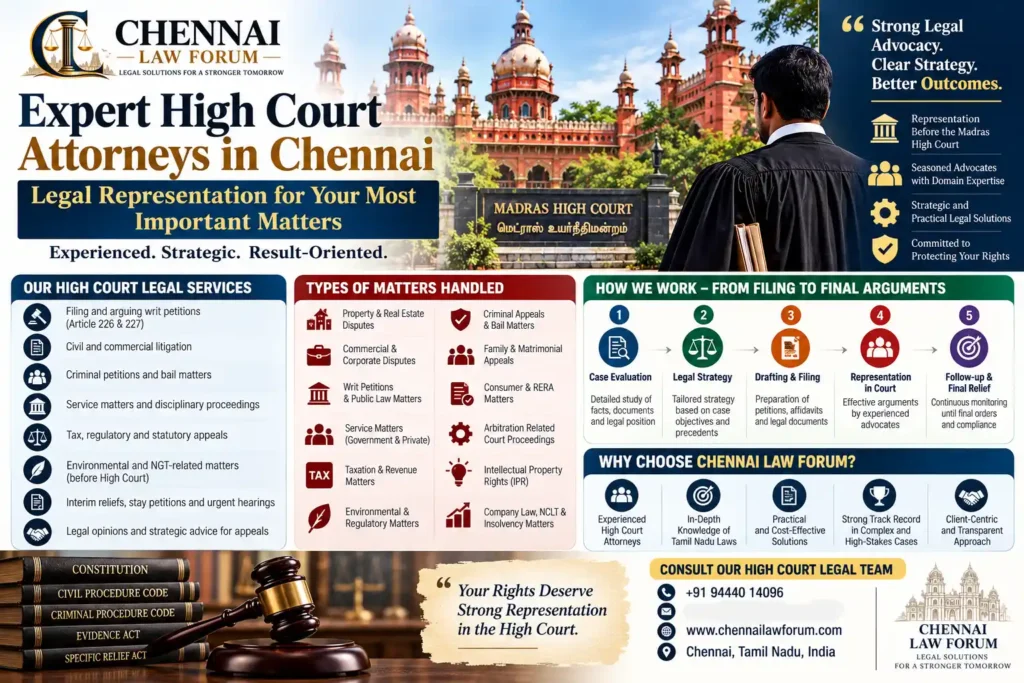
The Court exercises several kinds of powers:
- Original jurisdiction on its Original Side for certain civil suits, company matters and admiralty cases.
- Appellate jurisdiction over civil and criminal appeals from subordinate courts.
- Writ jurisdiction under Article 226 of the Constitution.
- Supervisory jurisdiction under Article 227 over courts and tribunals in the State.
- Inherent powers in criminal cases, now under section 528 of the Bharatiya Nagarik Suraksha Sanhita, 2023.
- Revisional jurisdiction in civil and criminal matters.
Writ petitions under Article 226
Article 226 gives the High Court power to issue writs to any person or authority for enforcing fundamental rights and for any other purpose.
The main writs are:
- Habeas corpus to produce a person who is illegally detained.
- Mandamus to compel a public authority to perform its duty.
- Certiorari to quash an illegal or unreasonable order.
- Prohibition to stop a lower authority from exceeding jurisdiction.
- Quo warranto to challenge the right of a person to hold a public office.
Typical writ cases in Chennai include:
- Government service and pension disputes.
- Tax and customs orders issued without jurisdiction or fair hearing.
- Land, patta and municipal disputes.
- License cancellations.
- Police inaction and illegal detention.
- Educational admissions.
A writ is a discretionary remedy. Expert High Court Attorneys in Chennai can help you determine whether filing a writ petition is the appropriate legal remedy for your case. A writ is a discretionary remedy, and the Court often considers whether an effective alternative remedy, such as a statutory appeal, is available. However, exceptions may apply where an authority has acted without jurisdiction, violated the principles of natural justice, or where the constitutionality of a law is challenged. Experienced legal guidance can help assess the merits of your case and identify the appropriate course of action before the Madras High Court.
Delay also matters. There is no fixed limitation for writs, but long and unexplained delay can defeat the petition.
Criminal practice before the High Court
Expert High Court Attorneys in Chennai must be familiar with the latest developments in criminal procedure, including the Bharatiya Nagarik Suraksha Sanhita, 2023 (BNSS), which replaced the Code of Criminal Procedure, 1973, with effect from 1 July 2024, subject to applicable transitional provisions. Understanding these legislative changes is essential when handling criminal appeals, bail applications, quashing petitions, and other criminal proceedings before the Madras High Court.
Common criminal petitions include:
- Anticipatory bail. Under section 482 BNSS, a person fearing arrest can ask the court for protection. The Sessions Court and the High Court have concurrent power.
- Regular bail. Under section 483 BNSS, the High Court can grant or cancel bail, including in serious offenses.
- Quashing of FIR or proceedings. Under section 528 BNSS, the Court can quash proceedings to prevent abuse of process or to secure the ends of justice.
- Criminal revision. A party aggrieved by an order of a Sessions Court or Magistrate can seek revision.
- Criminal appeals. Against conviction or acquittal, as the law permits.
- Transfer or fresh investigation. In suitable cases, the Court can transfer a case or direct a fair investigation.
Expert High Court Attorneys in Chennai can assist in preparing a well-drafted quashing petition that demonstrates why the allegations, even if accepted at face value, do not disclose the commission of an offence or why the dispute is essentially civil in nature or has been amicably settled. In appropriate cases, settlements in matrimonial and commercial disputes may constitute valid grounds for seeking quashing of criminal proceedings before the Madras High Court, subject to the applicable legal principles and judicial discretion.
Civil practice before the High Court
Civil matters reach the High Court in several ways.
- Second appeal under section 100 of the Code of Civil Procedure. It lies only on a substantial question of law, not on facts.
- Civil revision under section 115 CPC or Article 227 against certain interlocutory and final orders.
- First appeal against decrees of subordinate courts, as the law provides.
- Letters Patent Appeal or writ appeal against orders of a single judge, where allowed.
- Original Side suits within the Court’s pecuniary and subject-matter jurisdiction.
- Arbitration matters. Applications and appeals under the Arbitration and Conciliation Act, 1996.
- Company matters and some commercial disputes.
Expert High Court Attorneys in Chennai understand that identifying and properly pleading a substantial question of law is crucial when filing a second appeal before the Madras High Court. Courts generally do not entertain second appeals that merely seek a re-appreciation of evidence or a fresh assessment of factual findings. A well-prepared appeal must clearly establish the substantial question of law involved and demonstrate why judicial intervention is warranted under the applicable legal provisions.
Tribunal and statutory appeals
Many statutes send appeals from tribunals to the High Court. Examples:
- Income Tax Appellate Tribunal orders, on substantial questions of law.
- Customs, Excise and Service Tax Appellate Tribunal orders.
- Orders of the Debts Recovery Tribunal, which go first to the Appellate Tribunal.
- Labor Court and Industrial Tribunal awards, challenged by writ.
- Motor Accident Claims Tribunal awards, in appeal.
- Consumer commission orders, which go through the consumer hierarchy first.
Know the exact statutory time limit and any pre-deposit. Missing it can close the door.
Procedure and practical points
Practical steps make a difference.
- Choose the right remedy. The wrong petition wastes time.
- Check limitation. Many appeals have short periods, such as 30, 60 or 90 days.
- Collect certified copies. Lower court orders and records should be attached.
- File a caveat where needed. A caveat ensures you are heard before any ex parte order is passed against you.
- E-filing. The Court accepts electronic filing and holds hearings through physical and virtual modes. Follow its current rules.
- Draft with precision. Facts, grounds and prayers must be clear and concise. Judges read hundreds of pages a day.
- Seek interim relief carefully. Stay and interim directions depend on prima facie case, balance of convenience and irreparable harm.
Time and cost: what to expect
Expert High Court Attorneys in Chennai understand that every legal case has its own procedural requirements, timeline, and cost considerations. Urgent matters, such as bail applications, habeas corpus petitions, and stay applications, may receive priority listing, while final hearings of appeals and writ petitions can take longer depending on the Madras High Court’s docket and the complexity of the case.
Legal fees vary according to the nature of the dispute, the preparation required, the number of hearings, and the stakes involved. Experienced advocates should provide a transparent fee estimate and explain the likely stages of litigation before engagement. Be cautious of anyone who guarantees a favourable outcome, as no advocate can legitimately assure a particular judicial result.
Contempt and execution
Winning an order is not always the end. Sometimes authorities do not comply.
- Contempt of court. Wilful disobedience of a court order can be punished under the Contempt of Courts Act, 1971. The limitation for initiating contempt is one year.
- Execution. Civil decrees are enforced through execution proceedings.
- Fresh writs. Where an authority ignores a mandamus, further directions can be sought.
Plan for compliance from the start, and preserve proof of service of the order.
What makes Expert High Court Attorneys in Chennai?
When choosing counsel, look for:
- Real experience before the Madras High Court and its Registry practice.
- Strong drafting and research skills.
- Clear and honest communication.
- Availability for urgent mentions.
- Fair, transparent fees.
- Ethical conduct. A good advocate tells you the weak points of your case.
At Chennai Law Forum we prepare each matter as if it will be decided on the first hearing, because often it is.
How Expert High Court Attorneys in Chennai Law Forum help?
We represent clients in:
- Writ petitions and writ appeals.
- Bail, anticipatory bail and quashing petitions.
- Civil revision petitions and second appeals.
- Tax, customs and GST appeals before the High Court.
- Arbitration applications and appeals.
- Contempt petitions and execution matters.
For criminal defence support you may also visit CriminalAdvocate.in, and for civil litigation CivilAdvocate.in.
Frequently Asked Questions
Conclusion – Find Expert High Court Attorneys in Chennai
Expert High Court Attorneys in Chennai can help litigants pursue appropriate legal remedies before the Madras High Court, whether to challenge an unlawful order, protect personal liberty, or seek judicial intervention against an injustice. Effective High Court litigation requires careful case assessment, precise drafting, and a clear understanding of the applicable law and procedural requirements. Without proper preparation, litigation can lead to unnecessary delays and expenses.
Chennai Law Forum provides focused High Court legal representation, supported by meticulous drafting, transparent legal advice, and diligent case follow-up. Contact our legal team at the earliest opportunity to assess your case, understand your available remedies, and take timely steps to protect your legal rights.
Related Reading from Chennai Law Forum
- High Court appeal legal services
- High Court lawyers for criminal cases
- High Court lawyers for civil case filing
- Anticipatory bail lawyers in Chennai
- List of courts in Chennai and where to file
- District court appeal legal services
Need legal advice on this subject? Speak to Chennai Law Forum for a clear, confidential assessment of your matter.
Disclaimer: This article is for general information only. It is not legal advice, and the law and procedure may change. Please consult a qualified advocate before acting on any point discussed here.