

Financial Securities Legal Advisory – Financial securities regulate investments, capital markets, and commercial transactions across India’s financial ecosystem. Chennai Law Forum: Senior Lawyers Chamber provides strategic legal advisory for investors, companies, financial institutions, startups, brokers, portfolio managers, trusts, NGOs, and NRIs. Moreover, timely legal guidance minimizes regulatory risks and protects valuable investments. India’s securities framework primarily operates under the Securities and Exchange Board of India Act, 1992, Securities Contracts (Regulation) Act, 1956, Depositories Act, 1996, Companies Act, 2013, Limited Liability Partnership Act, 2008, Bharatiya Nyaya Sanhita, 2023, Bharatiya Nagarik Suraksha Sanhita, 2023, Bharatiya Sakshya Adhiniyam, 2023, and Civil Procedure Code, 1908 where applicable. Professional legal advice strengthens compliance, reduces litigation risks, and supports informed commercial decisions before regulatory authorities or judicial forums.
Financial Securities Legal Advisory: Chennai Law Forum Guidance – Senior Lawyers Chamber
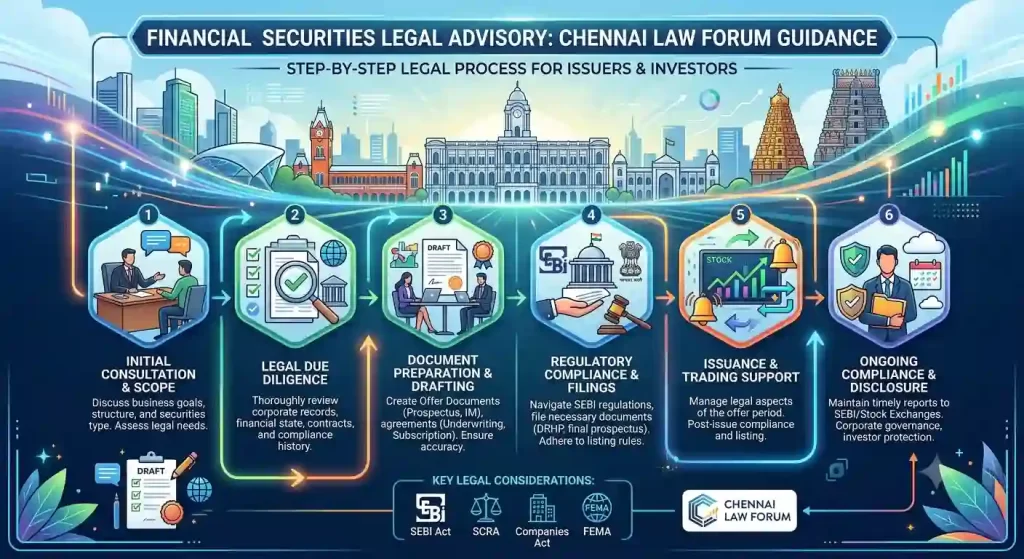
Importance of Financial Securities Legal Advisory
Investment transactions involve significant legal responsibilities alongside commercial opportunities. However, regulatory non-compliance often attracts investigations, penalties, and prolonged disputes. Professional legal advisory assists clients before investments, acquisitions, securities issuance, corporate restructuring, and regulatory filings. Additionally, lawyers examine agreements, disclosures, compliance obligations, shareholder rights, and contractual liabilities. Businesses also receive legal support during due diligence, fundraising, mergers, acquisitions, and private placements. Early legal intervention prevents regulatory violations while protecting investor interests. Consequently, organizations reduce financial exposure and strengthen governance standards. Preventive legal planning creates confidence among shareholders, investors, lenders, regulators, and business partners.
Key Laws Governing Financial Securities
Several statutes regulate India’s securities market and investment framework. Understanding these laws supports informed commercial decision-making.
| Law | Primary Purpose |
|---|---|
| SEBI Act, 1992 | Securities market regulation |
| Companies Act, 2013 | Corporate governance |
| Securities Contracts (Regulation) Act, 1956 | Securities trading regulation |
| Depositories Act, 1996 | Dematerialized securities |
| FEMA, 1999 | Cross-border investments |
| Prevention of Money Laundering Act, 2002 | Financial crime prevention |
Furthermore, businesses should monitor regulatory notifications issued by competent authorities. Updated legal compliance minimizes enforcement actions and commercial disputes.
Who Needs Securities Legal Advisory
Professional legal guidance benefits various market participants throughout investment transactions. Every stakeholder should evaluate statutory obligations before entering financial arrangements.
- Listed companies
- Private companies
- Startups
- Investors
- Shareholders
- Venture capital funds
- Foreign investors
- Brokers
- Depository participants
- Portfolio managers
- NGOs
- NRIs
Moreover, every transaction deserves careful legal examination. Early advisory services significantly reduce future litigation and regulatory complications.
Common Financial Securities Transactions
Financial securities law covers numerous commercial activities requiring statutory compliance. Chennai Law Forum: Senior Lawyers Chamber assists clients across complex financial transactions. Legal advisory includes public issues, rights issues, private placements, preferential allotments, share transfers, share purchase agreements, debenture issuance, venture capital investments, foreign direct investment, securities pledges, corporate restructuring, and shareholder agreements. Furthermore, lawyers review regulatory disclosures, investment documentation, and compliance obligations before execution. Accurate documentation reduces commercial uncertainty while protecting stakeholder interests. Consequently, organizations strengthen regulatory compliance and minimize disputes arising from defective securities documentation or contractual inconsistencies.
Major Securities Documents Reviewed
Proper legal review strengthens enforceability and regulatory compliance. Experienced lawyers examine several important commercial documents.
- Share Purchase Agreements
- Shareholders’ Agreements
- Subscription Agreements
- Debenture Trust Deeds
- Investment Agreements
- Securities Offering Documents
- Board Resolutions
- Disclosure Documents
- Due Diligence Reports
- Corporate Approvals
Additionally, comprehensive legal review identifies hidden contractual risks. Businesses receive practical recommendations before executing significant investment transactions.
Frequent Legal Issues
Financial securities transactions generate several legal challenges requiring timely professional intervention. Preventive legal advisory substantially reduces commercial risks.
- Insider trading allegations
- Disclosure violations
- Shareholder disputes
- Securities fraud
- Misrepresentation
- Corporate governance failures
- Breach of fiduciary duties
- Regulatory investigations
- Investment agreement disputes
- Compliance deficiencies
Therefore, organizations should obtain legal advice before disputes escalate. Early intervention protects investments and preserves valuable commercial relationships.
Regulatory Compliance, Jurisdiction, and Investor Protection
Financial securities compliance requires continuous adherence to statutory obligations and regulatory directions. Chennai Law Forum: Senior Lawyers Chamber advises clients throughout investment, fundraising, reporting, and enforcement proceedings. Moreover, proactive legal compliance minimizes enforcement risks and protects investor confidence. Businesses should maintain accurate statutory registers, board resolutions, disclosure records, financial statements, and corporate filings. Timely reporting before competent authorities strengthens regulatory transparency. Organizations should also conduct periodic compliance audits to identify potential violations. Consequently, businesses reduce exposure to penalties, suspension orders, and investor litigation. Preventive legal advisory safeguards commercial interests while supporting sustainable corporate governance and responsible securities market participation.
Regulatory Authorities and Government Departments
Several statutory regulators administer India’s securities market and corporate compliance framework. Jurisdiction depends upon transaction type, company status, investment structure, and applicable legislation. Moreover, businesses should cooperate with competent authorities during inspections, investigations, and adjudication proceedings. Important regulators include the Securities and Exchange Board of India, Ministry of Corporate Affairs, Reserve Bank of India, Registrar of Companies, Financial Intelligence Unit-India, Enforcement Directorate, Income Tax Department, and stock exchanges where applicable. Consequently, timely compliance reduces regulatory scrutiny and commercial uncertainty. Experienced legal representation strengthens responses during investigations, adjudication, settlement proceedings, and regulatory hearings.
Major Regulatory Authorities
Each authority performs distinct statutory responsibilities within India’s financial regulatory ecosystem. Understanding their jurisdiction improves legal compliance.
| Authority | Primary Responsibility |
|---|---|
| SEBI | Securities market regulation |
| Ministry of Corporate Affairs | Corporate governance |
| Registrar of Companies | Company filings |
| Reserve Bank of India | Foreign investment regulation |
| Financial Intelligence Unit-India | Financial intelligence compliance |
| Enforcement Directorate | FEMA and financial investigations |
Furthermore, organizations should monitor statutory notifications and regulatory circulars. Updated compliance substantially reduces enforcement risks.
Compliance Requirements
Businesses should establish structured compliance systems before undertaking securities transactions. Every statutory requirement deserves careful verification.
- Maintain statutory registers.
- Conduct board meetings.
- File regulatory disclosures.
- Preserve corporate records.
- Complete due diligence.
- Monitor insider trading restrictions.
- Verify investment documentation.
- Maintain financial transparency.
- Cooperate during investigations.
- Obtain legal review before transactions.
Additionally, periodic compliance audits strengthen investor confidence. Professional legal supervision minimizes procedural deficiencies and commercial exposure.
Common Securities Disputes
Commercial transactions frequently generate legal disputes requiring immediate professional assistance. Early legal intervention often prevents prolonged litigation.
- Insider trading investigations
- Share transfer disputes
- Corporate fraud
- Minority shareholder oppression
- Mismanagement allegations
- Disclosure violations
- Breach of investment agreements
- Market manipulation allegations
- Regulatory penalties
- Contractual disputes
Therefore, organizations should preserve documentary evidence from transaction inception. Strong legal preparation improves dispute resolution prospects before competent forums.
Legal Remedies Available
Indian law provides several remedies against unlawful securities practices and regulatory violations. Appropriate legal strategy depends upon the dispute and governing legislation.
- Regulatory representation
- Reply to statutory notices
- Adjudication proceedings
- Appeal before the Securities Appellate Tribunal
- Proceedings before the National Company Law Tribunal
- Appeal before the National Company Law Appellate Tribunal
- Civil litigation under the Civil Procedure Code where applicable
- Criminal complaints under the Bharatiya Nyaya Sanhita, 2023 where offences arise
- Writ petitions before jurisdictional High Courts
- Appeal before the Supreme Court
Furthermore, nearby police stations may investigate cognizable offences involving cheating, forgery, criminal breach of trust, identity theft, or investment fraud. Timely legal representation protects procedural rights throughout every stage.
Courts, Tribunals, and Professional Legal Support
Financial securities disputes may proceed before specialized tribunals, civil courts, constitutional courts, or criminal authorities depending upon statutory jurisdiction. Chennai Law Forum: Senior Lawyers Chamber represents clients before the Securities Appellate Tribunal, National Company Law Tribunal, National Company Law Appellate Tribunal, High Courts, and the Supreme Court of India. Civil Procedure Code, 1908 governs relevant civil proceedings. Bharatiya Nyaya Sanhita, 2023, Bharatiya Nagarik Suraksha Sanhita, 2023, and Bharatiya Sakshya Adhiniyam, 2023 govern criminal offences, investigation procedures, and evidentiary requirements where applicable. Consequently, experienced legal counsel ensures effective representation while protecting investor rights, corporate interests, and statutory compliance.
Types of Legal Support
Comprehensive legal services help clients manage financial securities matters confidently and lawfully.
- Securities law advisory
- SEBI compliance review
- Due diligence services
- Shareholder agreement drafting
- Corporate governance advisory
- Regulatory investigation support
- Notice reply drafting
- Tribunal representation
- Civil litigation
- Criminal defence
- Writ petition drafting
- Corporate compliance audits
Moreover, preventive legal advice remains the most effective strategy for reducing regulatory action, preserving investments, and maintaining long-term commercial stability.
Best Practices for Financial Securities Compliance
Develop a Robust Compliance Framework
Every organization should establish a structured compliance framework before undertaking securities transactions. Chennai Law Forum: Senior Lawyers Chamber recommends periodic legal audits and governance reviews. Moreover, management should monitor statutory amendments, SEBI regulations, and judicial developments regularly. Companies should maintain accurate statutory registers, board minutes, disclosure records, and investment documentation. Internal compliance teams should verify every transaction before execution. Regular employee training also strengthens awareness regarding insider trading, disclosure obligations, and fiduciary duties. Consequently, businesses reduce regulatory exposure and strengthen investor confidence. Preventive legal planning supports sustainable corporate growth while minimizing litigation risks before regulatory authorities and judicial forums.
Preserve Comprehensive Documentation
Proper documentation forms the foundation of effective securities compliance and dispute resolution. Businesses should securely maintain investment agreements, shareholder resolutions, board approvals, due diligence reports, financial statements, statutory filings, and regulatory correspondence. Furthermore, organizations should preserve electronic records with appropriate access controls. Regular document reconciliation identifies inconsistencies before inspections or investigations arise. Legal professionals should review significant transactions before execution. Consequently, businesses strengthen evidentiary support during regulatory proceedings, tribunal hearings, and civil litigation. Organized documentation also improves corporate transparency and protects shareholder interests throughout the investment lifecycle.
Respond Promptly to Regulatory Notices
Every regulatory communication deserves immediate legal attention. Organizations should examine notices carefully before preparing responses. Moreover, replies should include complete documentation and legally supported explanations. Timely submissions demonstrate responsible compliance before regulatory authorities. Businesses should also attend personal hearings whenever scheduled. Consequently, prompt legal representation frequently resolves disputes without extensive litigation. Early legal intervention safeguards commercial interests while preserving statutory rights available under applicable securities laws.
Financial Securities Compliance Checklist
Organizations should verify essential compliance obligations before completing investment or fundraising activities.
| Compliance Item | Status Check |
|---|---|
| Corporate Approvals | Verified |
| Statutory Registers | Updated |
| SEBI Compliance | Confirmed |
| Disclosure Filings | Completed |
| Due Diligence | Verified |
| Investment Agreements | Reviewed |
| Board Resolutions | Approved |
| Legal Audit | Completed |
Additionally, management should periodically review governance practices. Continuous compliance significantly reduces regulatory and commercial risks.
Why Choose Chennai Law Forum: Senior Lawyers Chamber
Strategic Legal Solutions for Financial Securities Matters
Chennai Law Forum: Senior Lawyers Chamber delivers comprehensive legal advisory for listed companies, private enterprises, startups, investors, venture capital funds, financial institutions, brokers, NGOs, trusts, and NRIs. Moreover, our senior lawyers assist clients with securities compliance, investment structuring, due diligence, regulatory investigations, corporate governance, tribunal proceedings, shareholder disputes, and constitutional litigation. We continuously monitor legislative amendments, regulatory circulars, and judicial precedents affecting financial markets. Consequently, clients receive practical legal solutions supported by current Indian laws. Our preventive advisory approach minimizes legal uncertainty while protecting investments and strengthening regulatory compliance.
Conclusion
Financial securities regulation demands careful planning, statutory compliance, and timely legal guidance. Businesses should maintain transparent governance, accurate documentation, and continuous regulatory monitoring. Moreover, investors should evaluate legal risks before executing significant financial transactions. Appropriate remedies remain available before regulatory authorities, tribunals, civil courts, and constitutional courts whenever disputes arise. Consequently, proactive legal compliance strengthens investor confidence and reduces commercial uncertainty. Chennai Law Forum: Senior Lawyers Chamber provides end-to-end legal support from advisory through litigation, enabling clients to protect investments while confidently navigating India’s evolving securities regulatory framework.
Frequently Asked Questions
Q1. Why should investors obtain legal advice before purchasing securities?
A. Professional legal advice identifies regulatory risks, verifies documentation, reviews disclosures, and protects investments before significant financial commitments.
Q2. Which authority regulates India’s securities market?
A. The Securities and Exchange Board of India regulates securities markets, investor protection, listed entities, intermediaries, and market compliance.
Q3. Where can securities disputes be resolved?
A. Depending upon jurisdiction, disputes may proceed before SEBI, the Securities Appellate Tribunal, NCLT, High Courts, or the Supreme Court.
Q4. What documents require legal review during investment transactions?
A. Lawyers review shareholder agreements, investment agreements, disclosure documents, board resolutions, due diligence reports, and statutory filings.
Q5. Can criminal proceedings arise from securities fraud?
A. Yes. Serious offences involving fraud, forgery, cheating, or criminal breach of trust may attract proceedings under applicable criminal laws.
Q6. How does legal advisory benefit companies and investors?
A. Professional legal support improves compliance, reduces regulatory risks, protects investments, manages disputes, and strengthens corporate governance.
Read More
- Financial Matter Legal Services: Expert Assistance from Chennai Law Forum
- Legal Assistance for Finance Companies: Chennai Law Forum Expertise
- Seeking Justice in Family Court: Legal Support from Chennai Law Forum
- Extradition & Mutual Legal Advisory: Expert Counsel in Chennai
- Legal Assistance for Export Trade Regulation: Chennai Law Forum Expertise
- Securities and Exchange Board of India (SEBI)